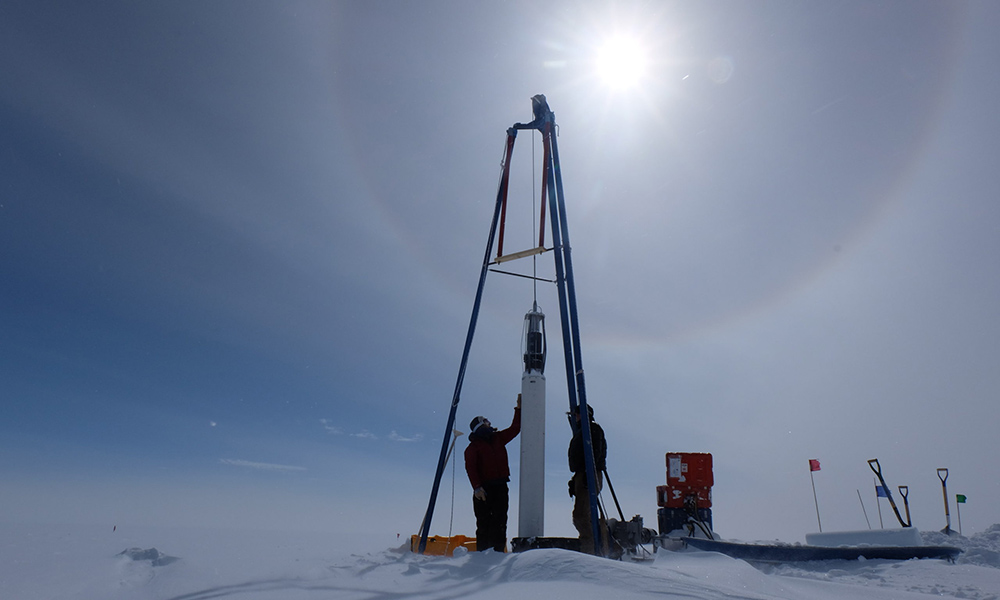
University of Rochester researchers in Greenland drill for ice cores, which contain air bubbles with small quantities of ancient air trapped inside. By measuring the carbon-14 isotope in air from more than 200 years ago, the researchers found that scientists have been vastly overestimating the amount of fossil methane emitted by natural sources, and have therefore been underestimating the amount of methane humans are emitting into the atmosphere via fossil fuels. Photo: Xavier Faïn / University of Grenoble Alpes

Methane emitted via human fossil fuel use “vastly underestimated”

By Lindsey Valich 19 February 2020 (University of Rochester) – Methane is a powerful greenhouse gas and large contributor to global warming. Methane emissions to the atmosphere have increased by approximately 150 percent over the past three centuries, but it has been difficult for researchers to determine exactly where these emissions originate; heat-trapping gases like […]

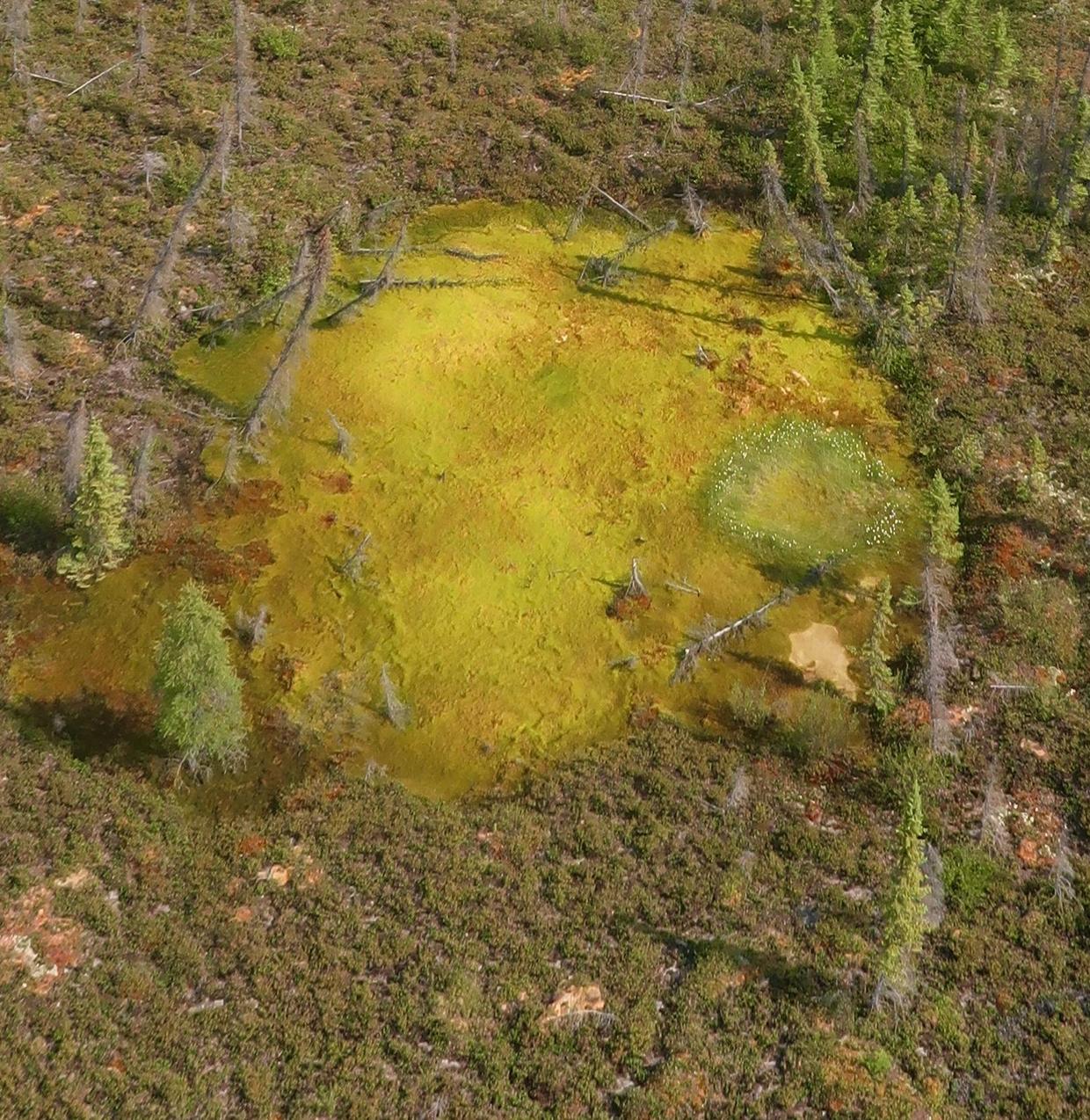
Aerial view of a sinkhole caused by rapid permafrost thawing. Abrupt thawing is “fast and dramatic” and it “affects landscapes in unprecedented ways” says Dr. Merritt Turetsky. Photo: Dr. Merritt Turetsky

“Fast and dramatic” permafrost thaw will double previous estimates of potential carbon emissions – “Forests can become lakes in the course of a month”

By Natacha Larnaud 4 February 2020 (CBS News) – Rapidly thawing permafrost in the Arctic has scientists worried. According to a new study published Monday in the journal Nature Geoscience, the ice that holds the soil together is melting, causing hillsides to collapse and massive sinkholes to open up as a result. And that dramatic disruption to […]

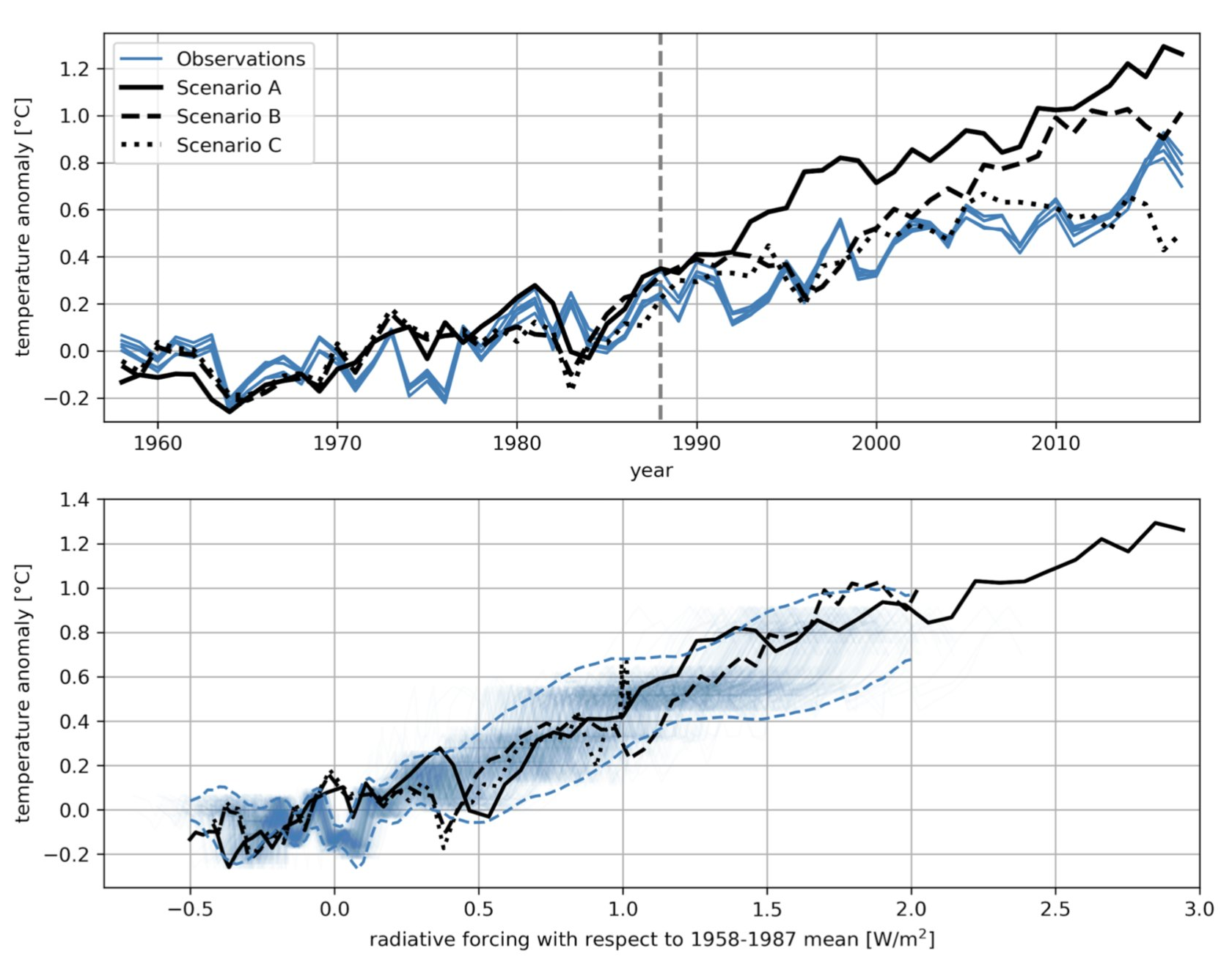
Hansen, et al. (1988) projections compared with observations on a temperature vs. time basis (top) and temperature vs. external forcing (bottom). Graphic: Hausfather, et al., 2019 / Geophysical Research Letters

Early climate modelers got global warming right, new report finds – “The warming we have experienced is pretty much exactly what climate models predicted it would be as much as 30 years ago”

By Robert Sanders 4 December 2019 (Berkeley News) – Climate skeptics have long raised doubts about the accuracy of computer models that predict global warming, but it turns out that most of the early climate models were spot-on, according to a look-back by climate scientists at the University of California, Berkeley, Massachusetts Institute of Technology […]

Carbon dioxide emissions from natural gas, petroleum, coal, and land use changes, 1998-2017, in gigatons of CO2 per year. Graphic: GCP

Global carbon emissions growth slows, but still hits record high in 2019 – “Emissions cuts in wealthier nations must outpace increases in poorer countries where access to energy is still needed”

By Rob Jordan 3 December 2019 (Stanford News Service) – The runaway train that is climate change is about to blow past another milestone: global fossil-fuel carbon dioxide emissions will reach yet another record high. Driven by rising natural gas and oil consumption, levels of CO2 are expected to hit 37 billion metric tons this […]

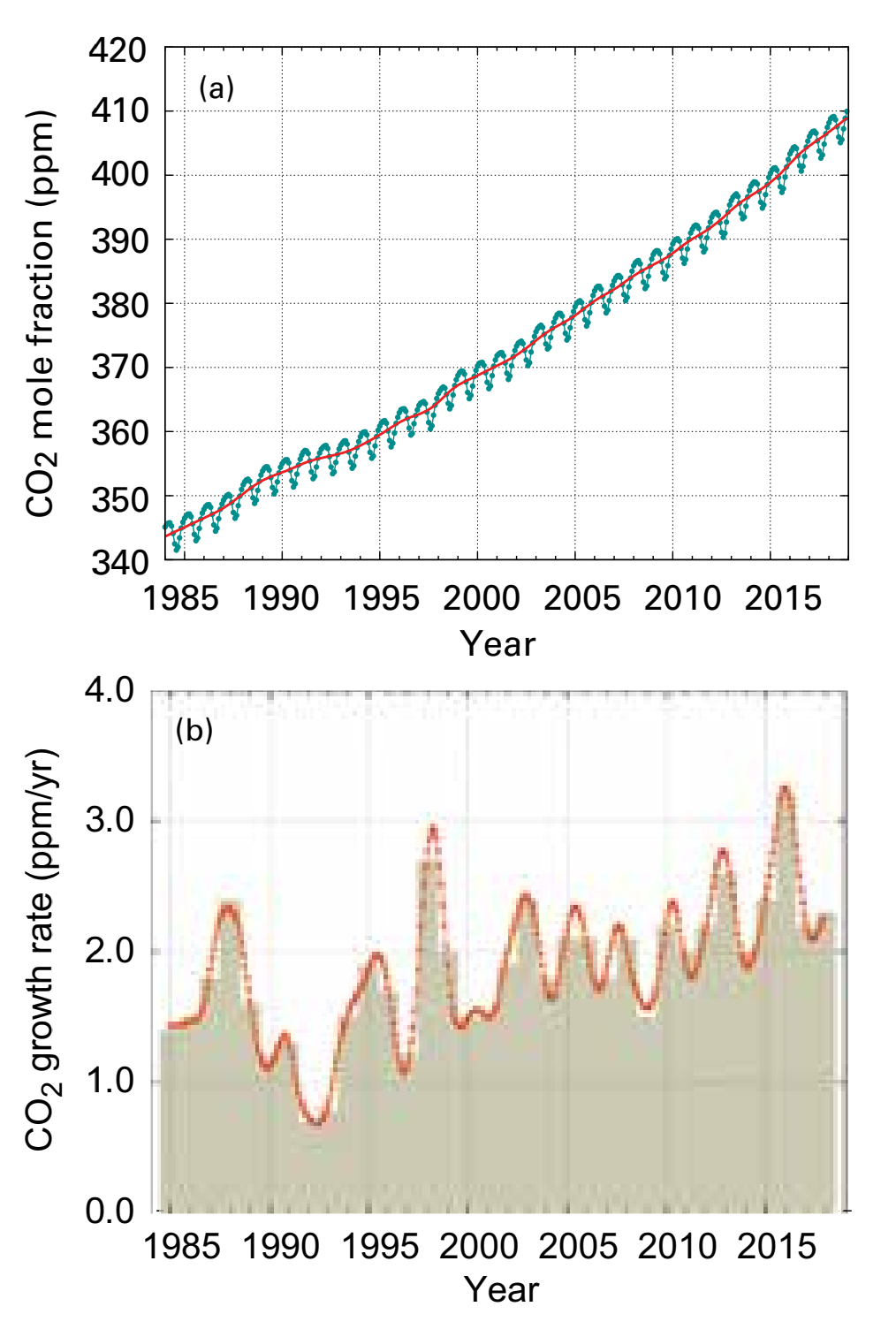
Globally averaged CO2 mole fraction (a) and its growth rate (b) from 1984 to 2018. Increases in successive annual means are shown as shaded columns in (b). The red line in (a) is the monthly mean with the seasonal variation removed; the blue dots and line depict the monthly averages. Observations from 129 stations have been used for this analysis. Graphic: WMO

Greenhouse gas concentrations in atmosphere reached yet another high in 2018

GENEVA, 25 November 2019 (WMO) – Levels of heat-trapping greenhouse gases in the atmosphere have reached another new record high, according to the World Meteorological Organization. This continuing long-term trend means that future generations will be confronted with increasingly severe impacts of climate change, including rising temperatures, more extreme weather, water stress, sea level rise […]

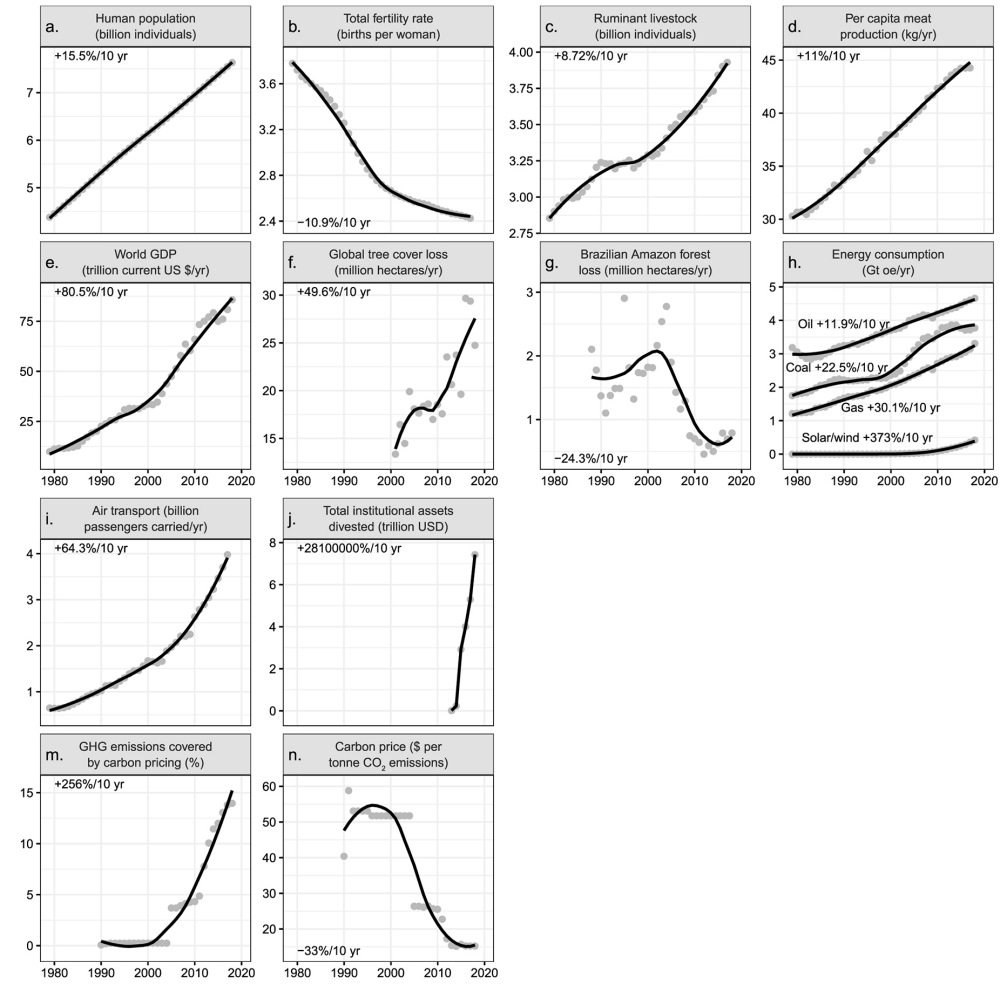
Graphs showing change in global human activities from 1979 to the present. Graphic: Ripple, et al., 2019 / BioScience

More than 11,000 scientists issue warning of climate emergency – “An immense increase of scale in endeavors to conserve our biosphere is needed to avoid untold suffering due to the climate crisis”

5 November 2019 (BioScience) – Scientists have a moral obligation to clearly warn humanity of any catastrophic threat and to “tell it like it is.” On the basis of this obligation and the graphical indicators presented below, we declare, with more than 11,000 scientist signatories from around the world, clearly and unequivocally that planet Earth […]

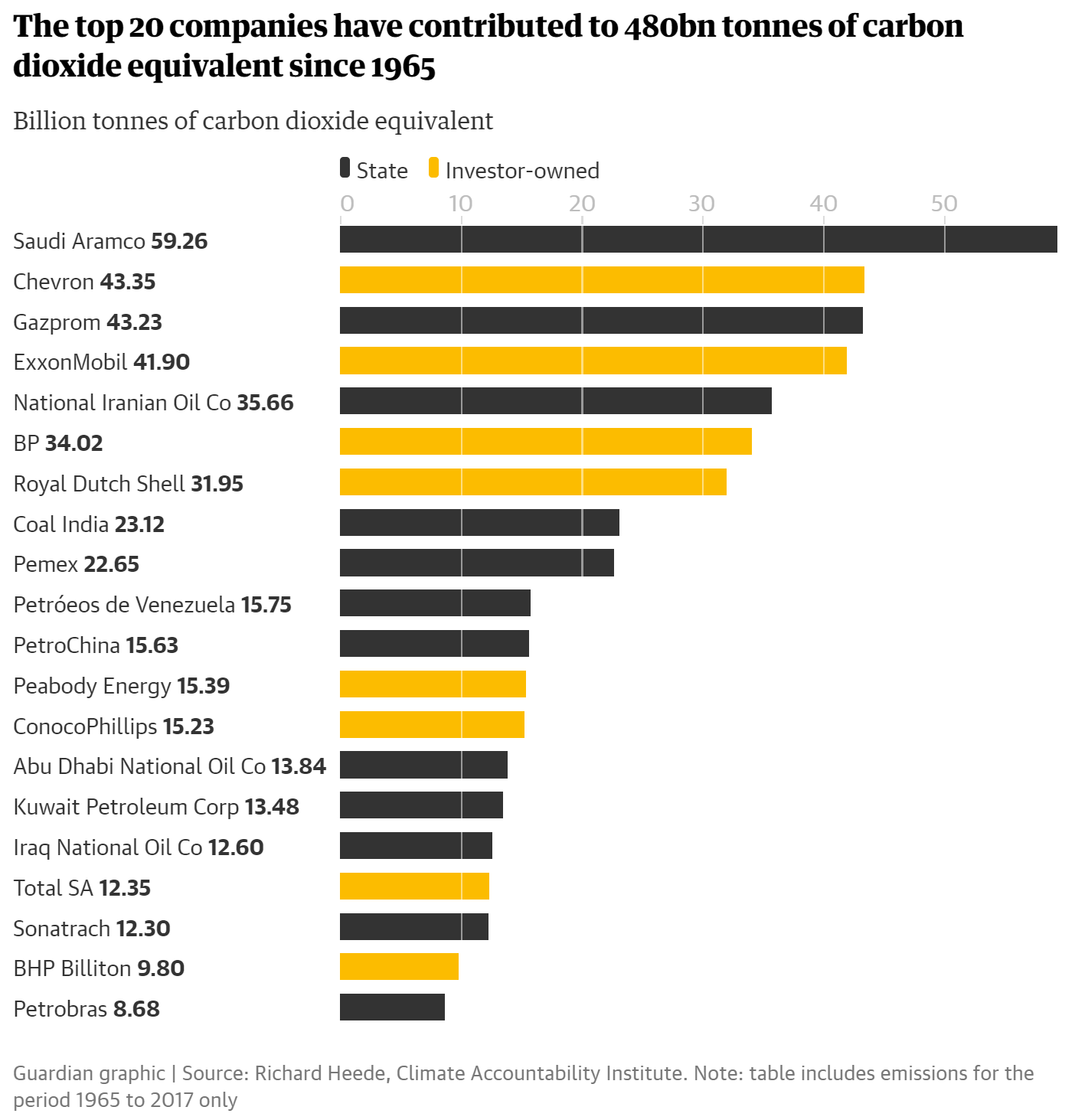
The top 20 companies that have contributed to 480 billion tonnes of carbon dioxide equivalent since 1965. At the top is Saudi Aramco, followed by Chevron, Gazprom, and Exxon Mobil. Data: Richard Heede / Climate Accountability Institute. Graphic: The Guardian

Revealed: the 20 firms behind a third of all carbon emissions – “The great tragedy of the climate crisis is that seven and a half billion people must pay the price so that a couple of dozen polluting interests can continue to make record profits”

By Matthew Taylor and Jonathan Watts 9 October 2019 (The Guardian) – The Guardian today reveals the 20 fossil fuel companies whose relentless exploitation of the world’s oil, gas and coal reserves can be directly linked to more than one-third of all greenhouse gas emissions in the modern era. New data from world-renowned researchers [Climate […]

An expedition aboard the “Academic Mstislav Keldysh” discovered a 50-square-foot patch of bubbling methane in the East Siberian Sea Photo: Shirshov Institute of Oceanology

Russian scientists find giant methane fountains in Arctic Ocean – “This is the most powerful seep I have ever been able to observe”

By Alec Luhn 8 October 2019 MOSCOW (The Telegraph) – Russian scientists in the Arctic Ocean said they have discovered the most powerful methane gas fountain ever recorded, highlighting the danger of this greenhouse gas accelerating climate change or causing an oil or gas spill as it erupts from thawing permafrost. A research expedition from […]

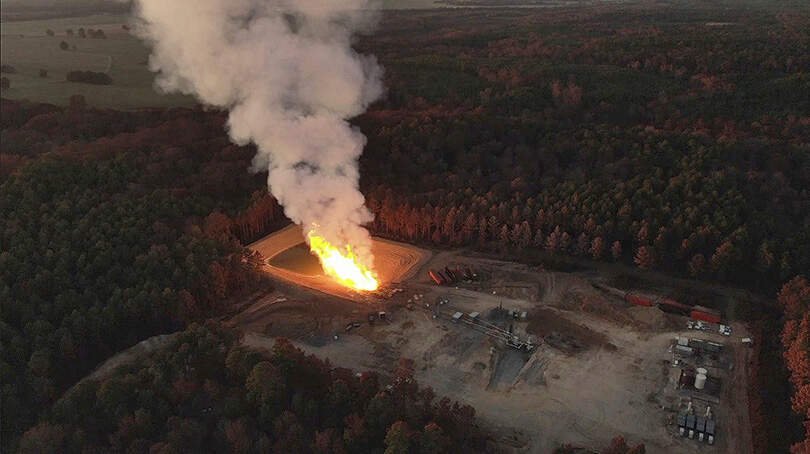
Screenshot from drone video of a fracked gas well blowout at wells operated by GEP Haynesville, LLC, in Red River Parish, Louisiana, on 1 October 2019. According to Patrick Courreges with LDNR, the well heads have been initially capped and the flow redirected through piping to flare pits to contain the produced water and keep the heat away from the wellheads where workers are trying to kill the wells at surface. Photo: Phin Percy Jr.

Already burning for five weeks, fracked gas blowout in Louisiana could last two more months

By Julie Dermansky 4 October 2019 (DeSmog) – For the fifth week since the blowout began, a large flare is still burning at the site of GEP Haynesville, LLC’s blown out fracked gas wells in northwestern Louisiana. The blowout occurred on 30 August 2019, shortly after the company began a frack job, igniting two adjacent wells. A state official estimated […]

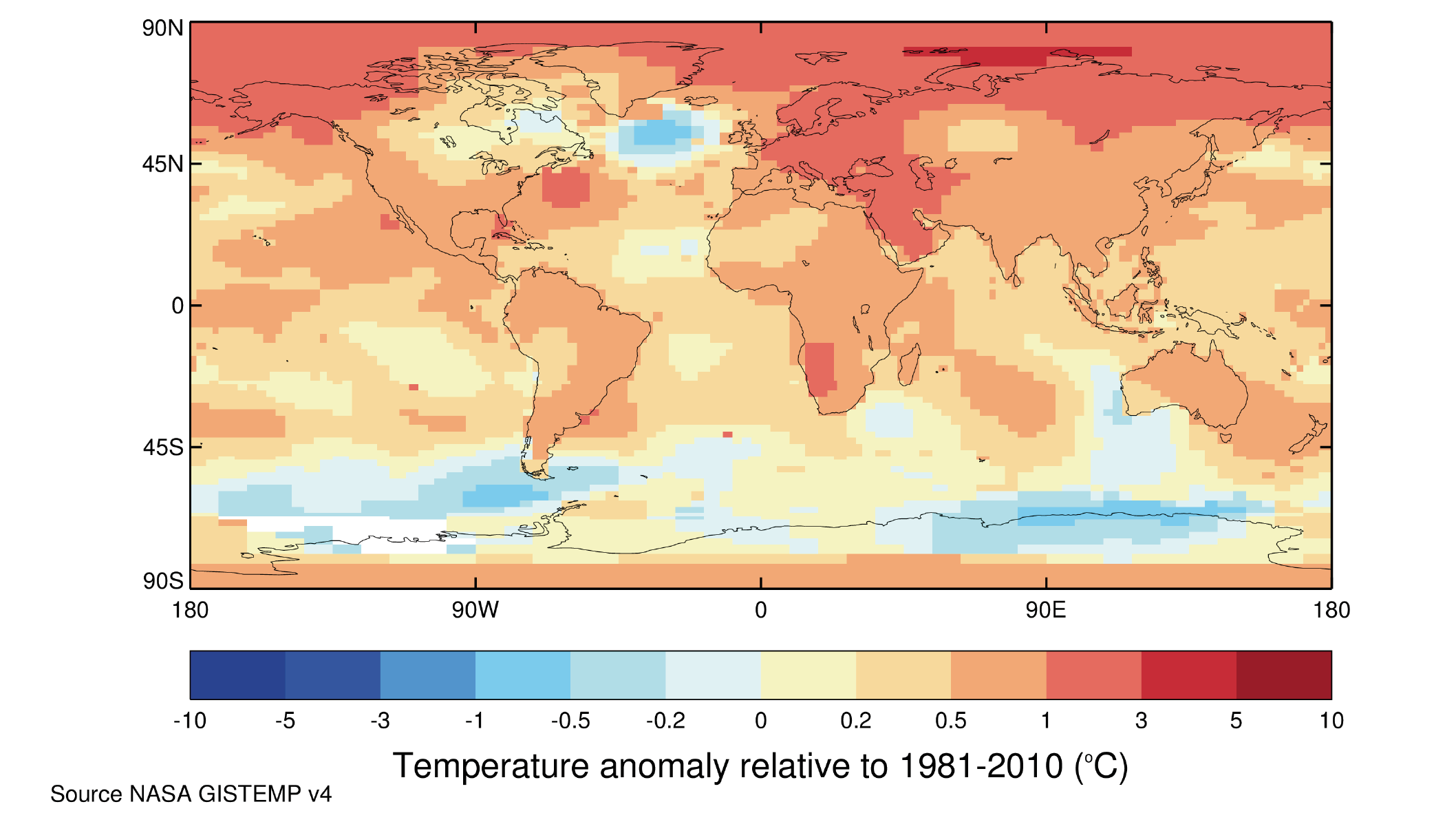
Map showing 2015–2019 five-year average temperature anomalies relative to the 1981-2010 average. Data: NASA GISTEMP v4. through June 2019. Graphic: WMO

Landmark “United in Science” report brings together world’s leading climate science organizations

NEW YORK, 22 September 2019 (WMO) – The world’s leading climate science organizations have joined forces to produce a landmark new report  [pdf] for the United Nations Climate Action Summit, underlining the glaring – and growing – gap between agreed targets to tackle global warming and the actual reality. The report, United in Science, includes details on the […]
Social media & sharing icons powered by UltimatelySocial