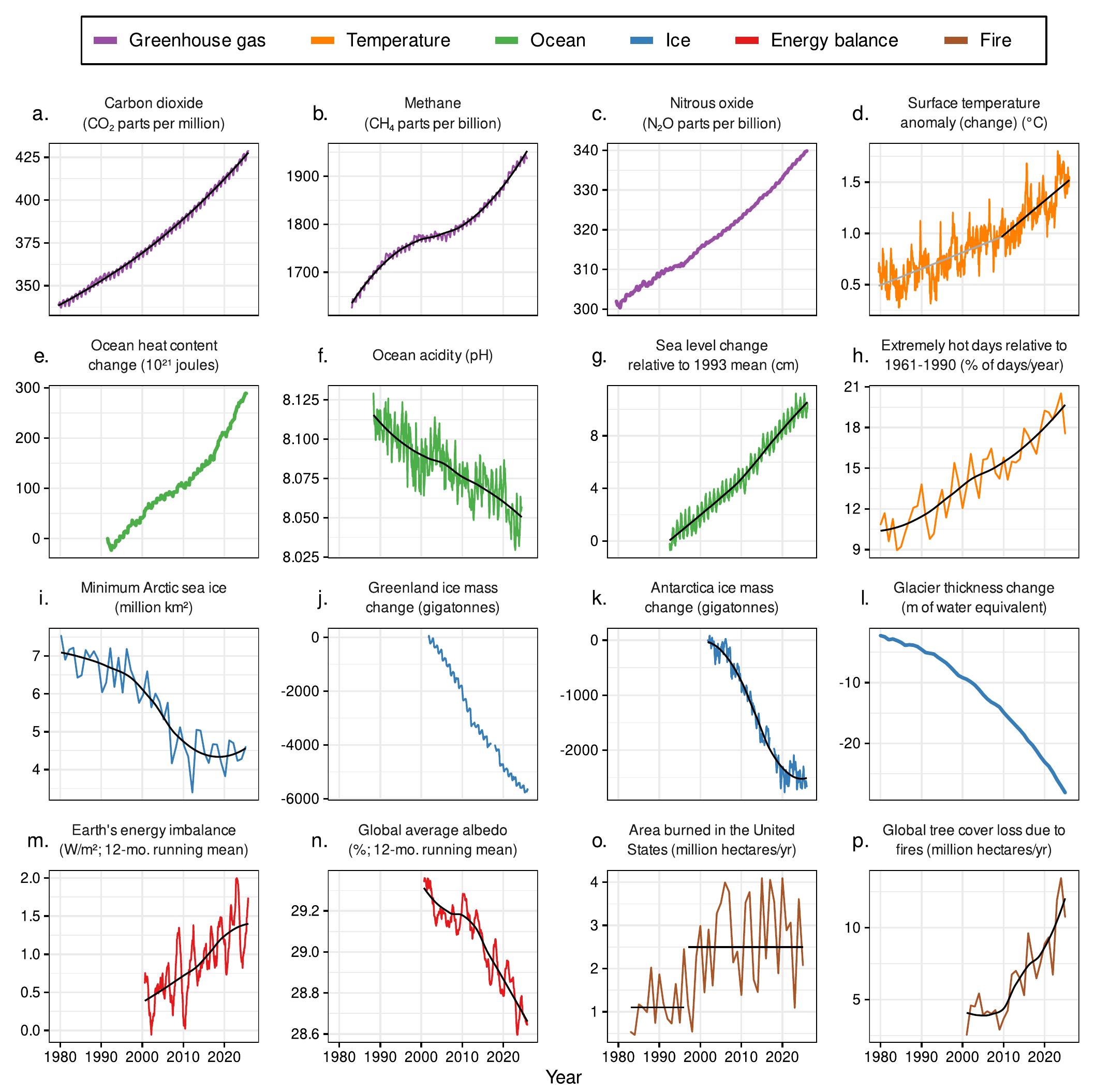
Time series of climate-related responses, the planetary vital signs, 1980-2026. Of 16 vital signs spanning greenhouse gas concentrations, temperatures, the oceans, ice, energy balance, and wildfire, 7 (44 percent) are currently at record extremes, and several show evidence of acceleration or abrupt shifts. For surface temperature anomaly (d), estimates based on a segmented linear regression model are shown in gray (prior to 2010) and black (beginning in 2010). For area burned (o), the black horizontal lines show changepoint model estimates, which indicate abrupt shifts. For other variables with relatively high variability, local regression trendlines are shown in black. The variables were measured at various frequencies (e.g., annual, monthly, weekly). The labels on the x-axis correspond to midpoints of years. Graphic: Ripple, et al., 2026 / BioScience

Seven of 16 planetary vital signs are at record extremes, scientists report – Global warming has accelerated to 0.36°C per decade since 2010, and 2°C could be reached before 2050 – “This is no longer a warning for the future; it is a diagnosis of the present”

14 October 2026 (BioScience) – We are witnessing the rapid destabilization of the Earth’s climate system. This is no longer a warning for the future; it is a diagnosis of the present. Earth’s life-support systems are being pushed beyond stable limits, with changes unfolding faster than our ability to respond. Human activities are driving profound […]

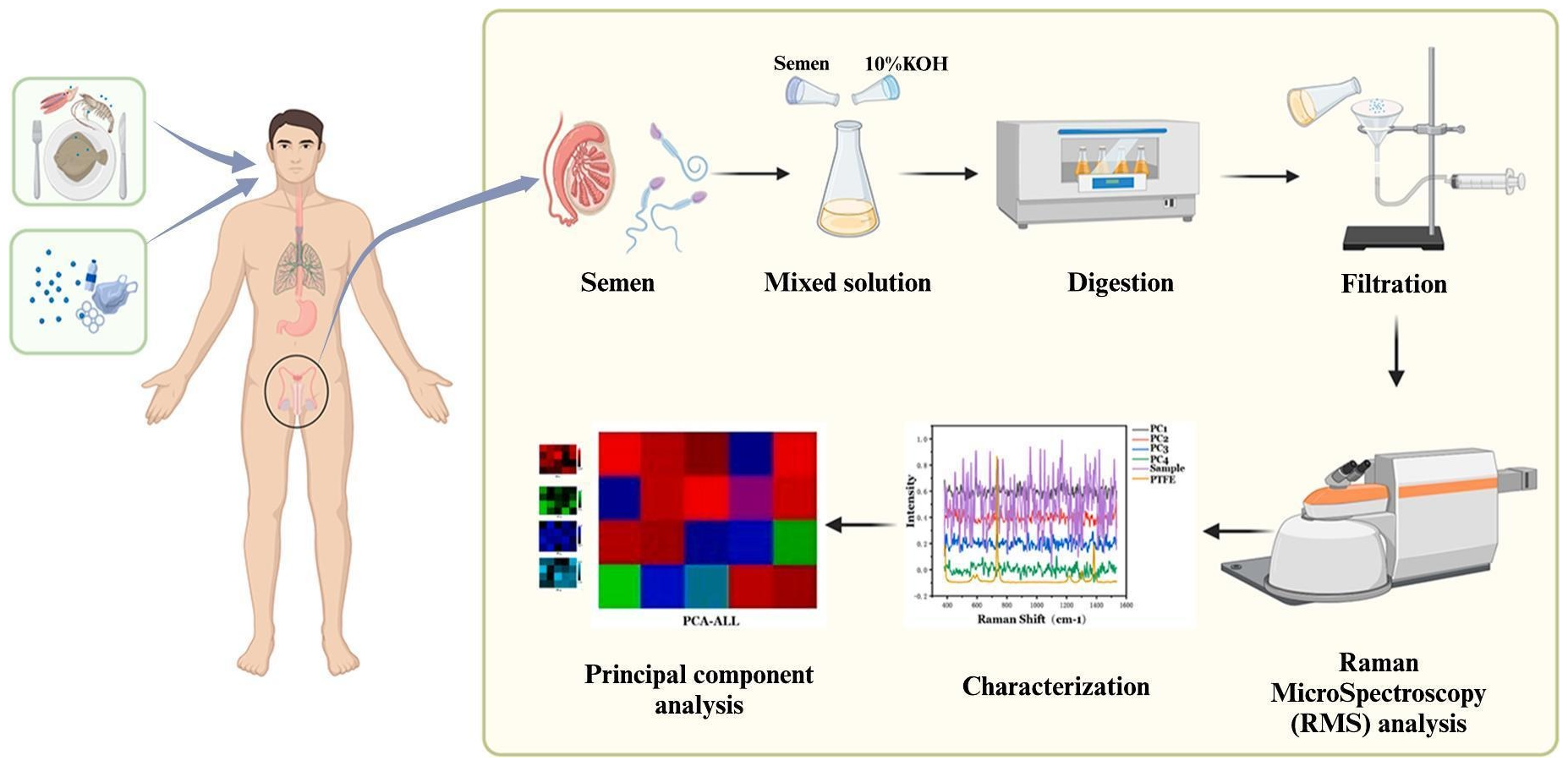
Diagram showing how microplastics enter the human body and are detected in semen by using Raman spectroscopy. Graphic: Li, et al., 2024 / Science of The Total Environment

Microplastics found in every human semen sample tested in study – “There is a need for action to avoid additional permanent damage to the planet and the human body”

By Damian Carrington 10 June 2024 (The Guardian) – Microplastic pollution has been found in all human semen samples tested in a study, and researchers say further research on the potential harm to reproduction is “imperative”. Sperm counts in men have been falling for decades and 40% of low counts remain unexplained, although chemical pollution has been implicated by many […]

A man stands near his home looking at a street he says has been flooded for months, on Thursday, 7 December 2023, in Prichard, Alabama. Water bubbles up in streets, pooling in neighborhoods for weeks or months. Homes burn to the ground if firefighters can’t draw enough water from hydrants. Utility crews struggle to fix broken pipes while water flows through shut-off valves that don’t work. Photo: Brynn Anderson / AP Photo

Trillions of gallons leak from aging drinking water systems, further stressing shrinking U.S. cities – “It’s a huge problem because infrastructure is rapidly deteriorating”

By Tammy Webber 4 March 2024 PRICHARD, Alabama (AP) – Water bubbles up in streets, pooling in neighborhoods for weeks or months. Homes burn to the ground if firefighters can’t draw enough water from hydrants. Utility crews struggle to fix broken pipes while water flows through shut-off valves that don’t work. For generations, the water […]

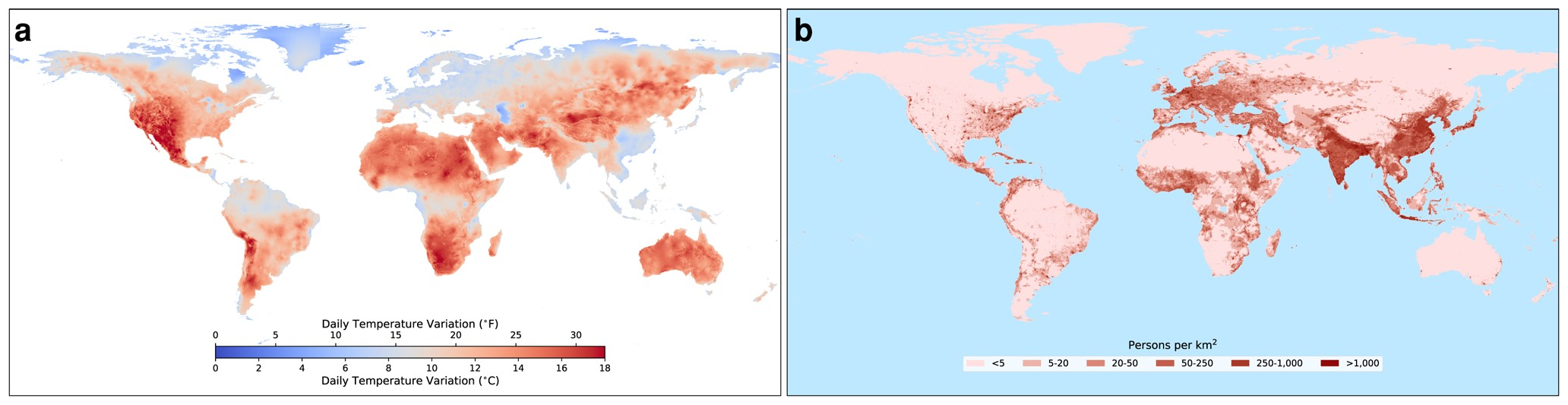
Maps showing daily temperature variation (DTV, a) and population density in the world (b). Graphic: Liu and Smith-Greenaway, 2024 / PNAS Nexus

Study finds Black and Hispanic Americans are disproportionately exposed to wider temperature swings

22 May 2024 (PNAS Nexus) – Extreme heat can harm human health, but so can extreme temperature swings. Large daily temperature variation (DTV) has been associated with elevated mortality in studies around the world. Trees and other vegetation can lower DTV, as trees reduce temperature through transpiration during the day and also trap long-wave radiation […]

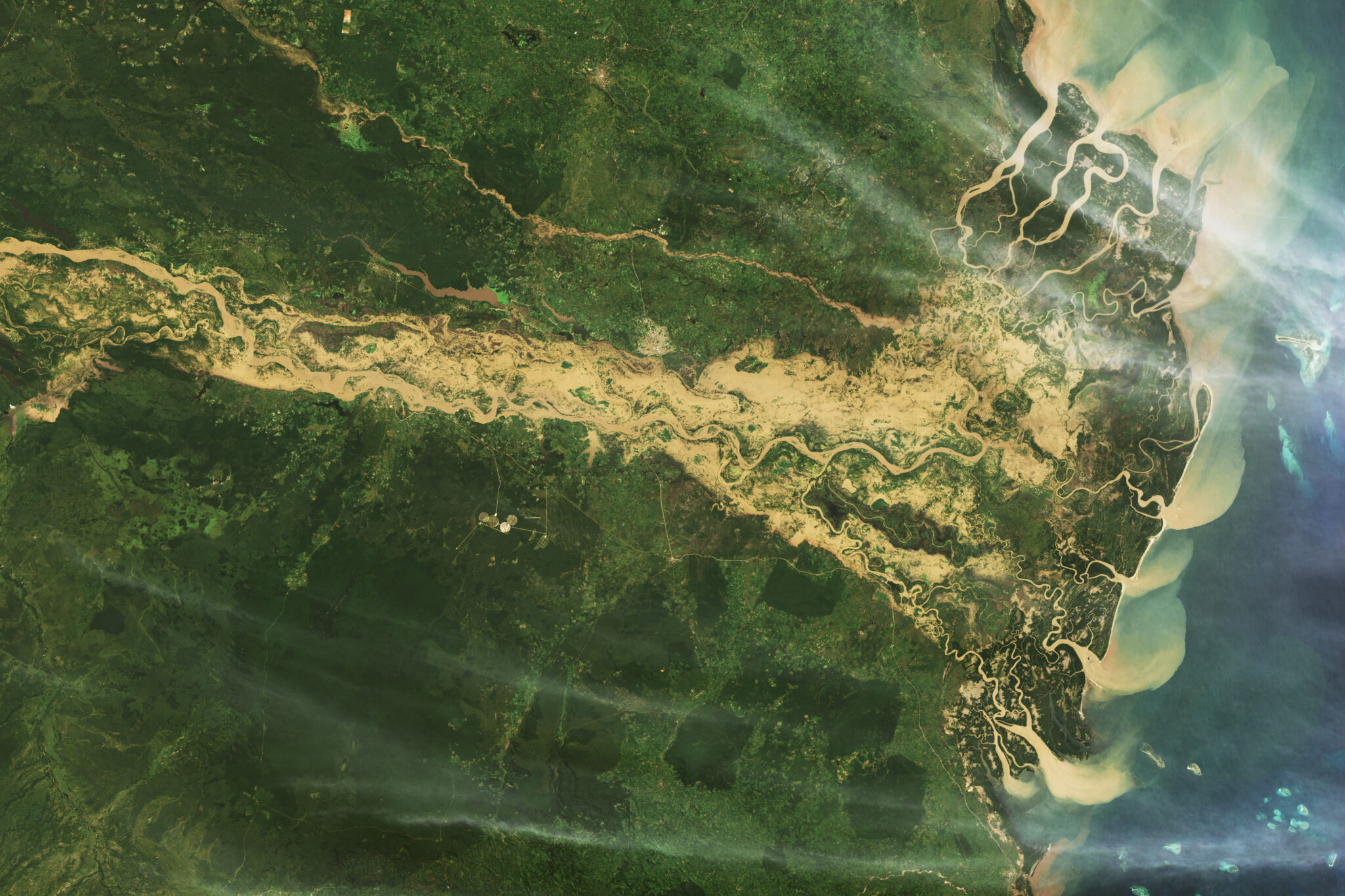
Satellite view of severe flooding on the Rufiji River in Tanzania on 2 May 2024. Photo: NASA

Climate change and rapid urbanization worsened the impact of East African rains, scientists say – “We’re likely to see this kind of intensive rainfall happening this season going into the future”

By Carlos Mureithi 23 May 2024 NAIROBI, Kenya (AP) – The impact of the calamitous rains that struck East Africa from March to May was intensified by a mix of climate change and rapid growth of urban areas, an international team of climate scientists said in a study published Friday. The findings come from World Weather Attribution, […]

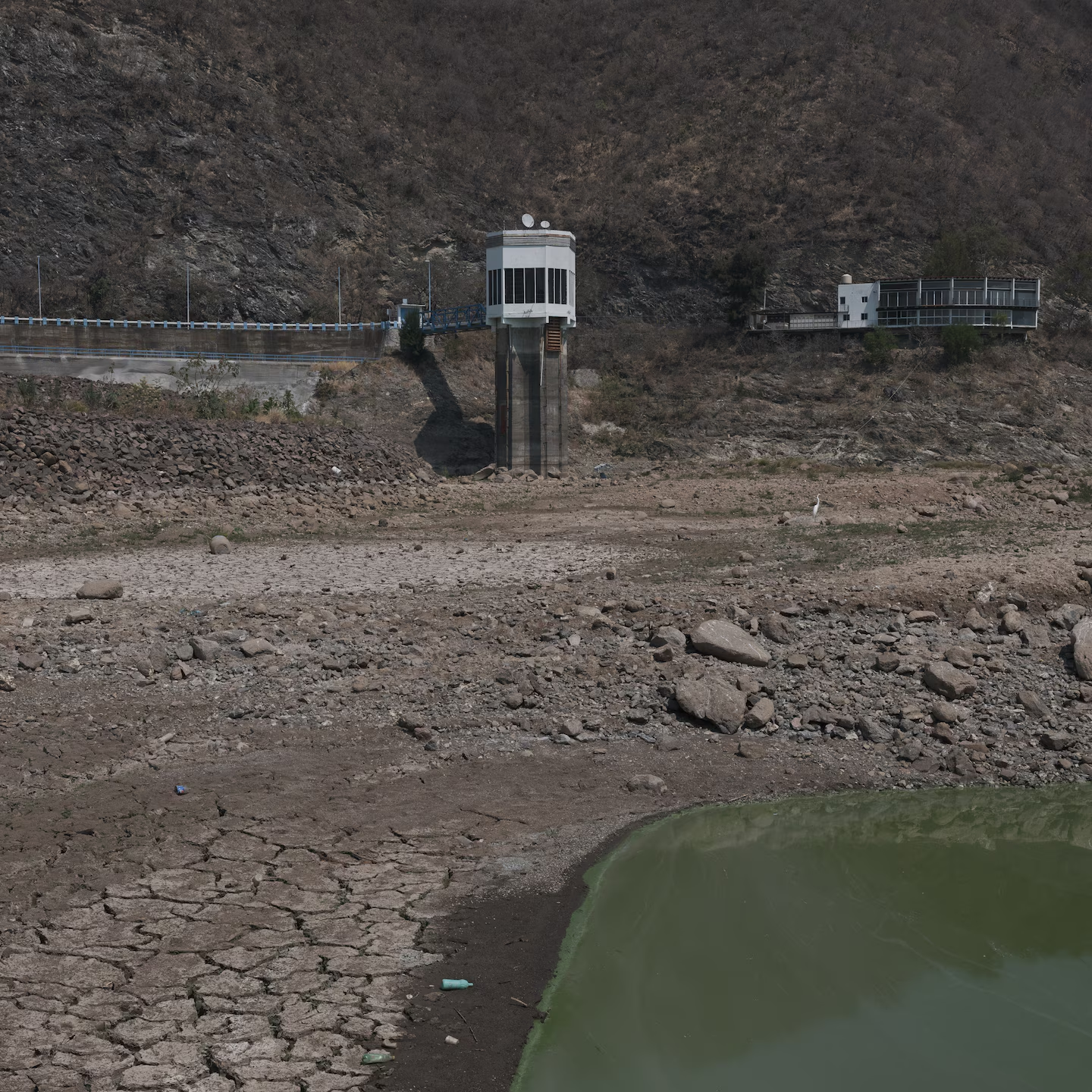
Low water levels at the Miguel Aleman dam in May 2024. Photo: Luis Antonio Rojas / The Washington Post

Mexico City’s water “Day Zero” may come even for the wealthiest residents – “No one could have foreseen this would happen in the city”

By Kasha Patel 25 May 2024 MEXICO CITY (The Washington Post) – Raquel Campos’ water issues started in January, when her condo building’s manager sent residents a message saying that the city hadn’t delivered water to its cistern. Four days later, taps in the upscale residence went dry. Campos has lived in the wealthy Polanco […]

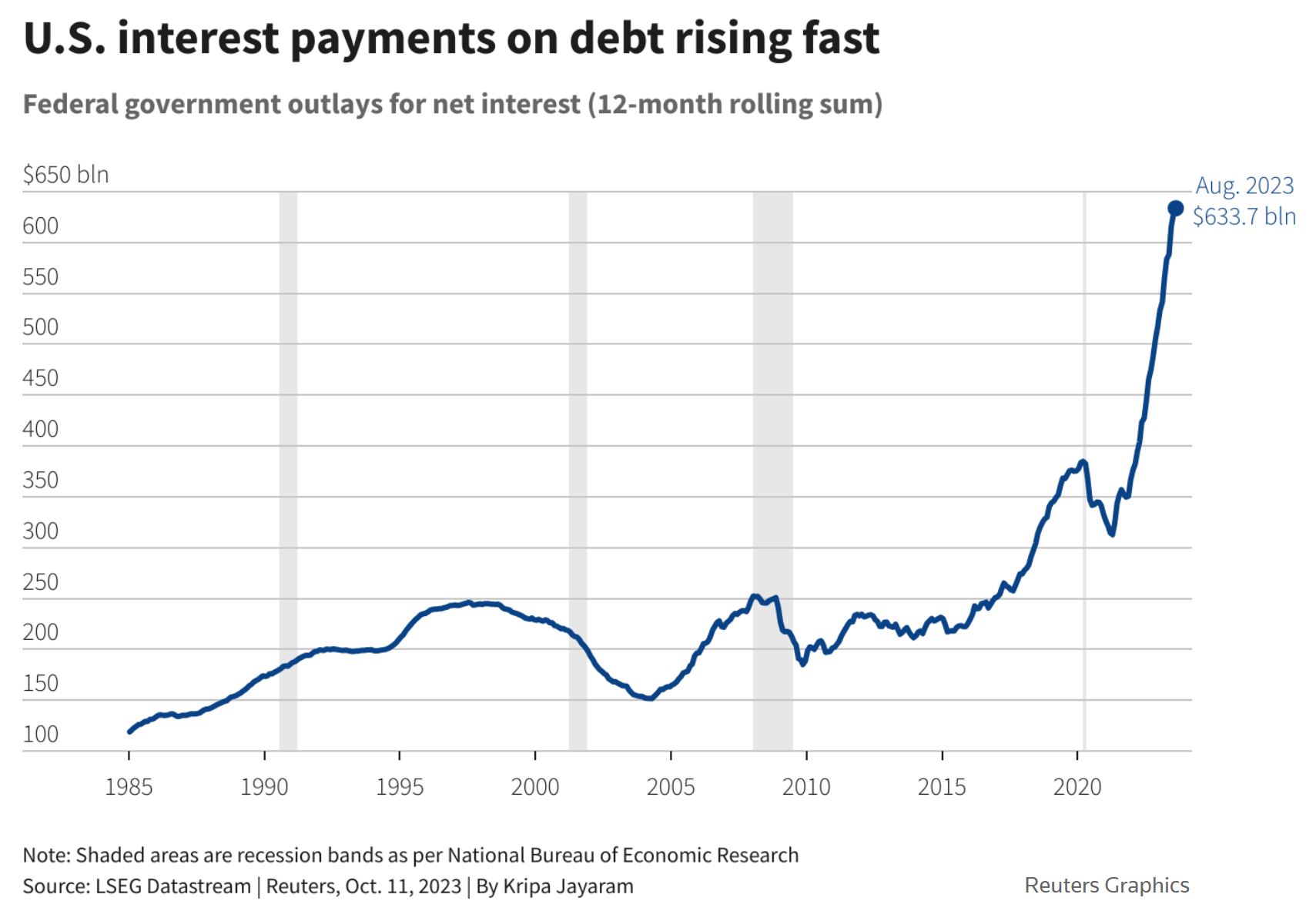
U.S. federal government outlays for net interest (12-month rolling sum), 1985-2023. Data are current through August 2023. Data: LSEG Datastream. Graphic: Kripa Jayaram / Reuters

As global debt worries mount, is another crisis brewing? “You can take many, many countries today, and you will see that we are not far away from a public finances crisis”

By Yoruk Bahceli, Dhara Ranasinghe, and Maria Martinez 16 October 2023 LONDON (Reuters) – Record debts, high interest rates, the costs of climate change, health, and pension spending as populations age and fractious politics are stoking fears of a financial market crisis in big, developed economies. A surge in government borrowing costs has put high debt in […]

Number of generic extinctions per century among in different classes of vertebrates. The low number of reptiles and amphibia, which underestimate the magnitude of extinction pattern, is probably the result of the lack of information in earlier centuries, where very few species had been described. The dotted line represents the background extinction rate. Graphic: Ceballos and Ehrlich, 2023 / PNAS

Study finds human-driven mass extinction is eliminating entire branches of the tree of life – “We’re losing our only known living companions in the entire universe”

By Sean Cummings 18 September 2023 (Stanford News) – The passenger pigeon. The Tasmanian tiger. The Baiji, or Yangtze River dolphin. These rank among the best-known recent victims of what many scientists have declared the sixth mass extinction, as human actions are wiping out vertebrate animal species hundreds of times faster than they would otherwise […]

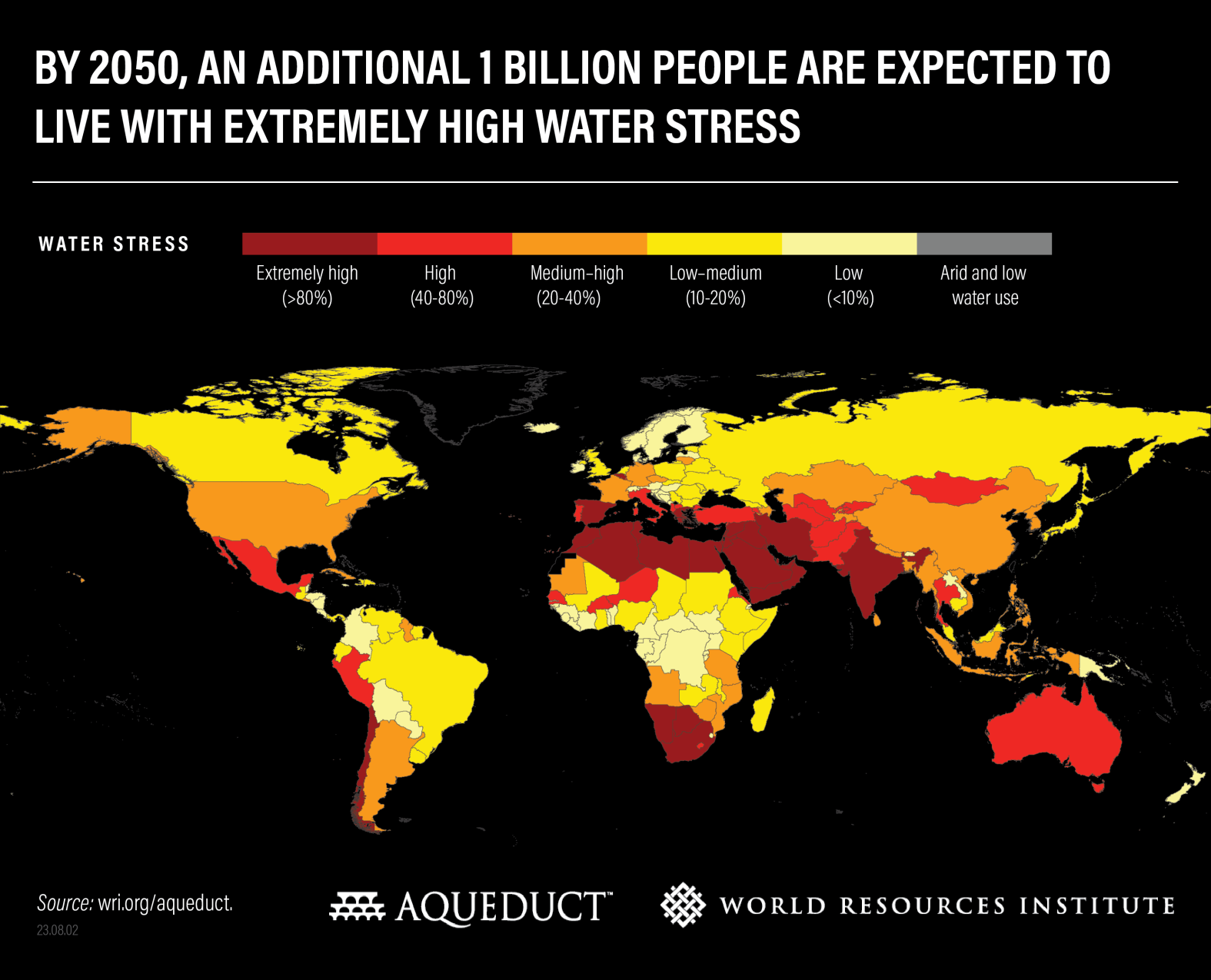
Map showing global water stress projected to 2050. By 2050, an additional 1 billion people are expected to live with extremely high water stress, even if the world limits global temperature rise to 1.3 degrees C to 2.4 degrees C (2.3 degrees F to 4.3 degrees F) by 2100, an optimistic scenario. Global water demand is projected to increase by 20 percent to 25 percent by 2050, while the number of watersheds facing high year-to-year variability, or less predictable water supplies, is expected to increase by 19 percent. Data: wri.org/aqueduct. Graphic: WRI

25 countries, housing one-quarter of the population, face extremely high water stress – By 2050, an additional 1 billion people will live with extremely high water stress

By Samantha Kuzma, Liz Saccoccia, and Marlena Chertock 16 August 2023 (WRI) – New data from WRI’s Aqueduct Water Risk Atlas show that 25 countries — housing one-quarter of the global population — face extremely high water stress each year, regularly using up almost their entire available water supply. And at least 50% of the world’s population […]

Correlation of significant shifts in or appearances of markers between sites documenting the onset of the Anthropocene. Collectively, the 12 reference sites, via analysis across many sites using similar multiple proxies, show the extent to which the proxies at each site cluster at an approximately coincident level around the mid-20th century, consistent with the Great Acceleration Event Array (GAEA) proposed by Waters et al. (2022). This demonstrates the degree to which the primary marker chosen at a site represents the range of critical changes encompassed by that section. Each site team has identified a level where significant changes cluster, these ranging in age between 1945 and 1968 CE, though for most sites the level chosen dates to the 1950s. Graphic: Waters, et al., 2023 / The Anthropocene Review

Canadian lake sediments reveal start of Earth’s Anthropocene epoch – “Clearly, the biology of the planet has changed abruptly. We cannot go back to a Holocene state now.”

By David Stanway 11 July 2023 (Reuters) – Sediment deposited at Crawford Lake, a small but deep body of water in Canada’s Ontario province, provides unmistakable evidence that Earth entered a new human-driven geological chapter – the Anthropocene epoch – some seven decades ago, a team of scientists said on Tuesday. The members of the […]
Social media & sharing icons powered by UltimatelySocial