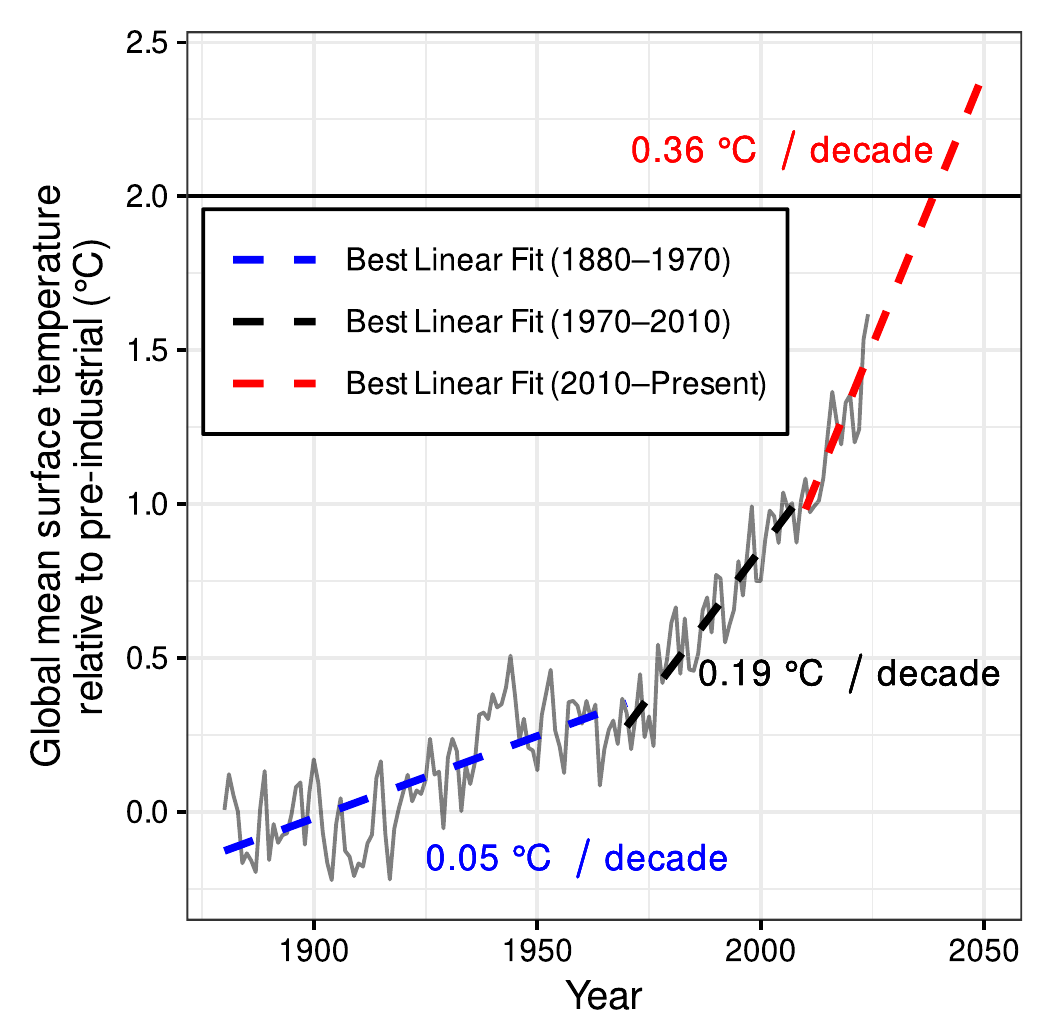
Seven of 16 planetary vital signs are at record extremes, scientists report – Global warming has accelerated to 0.36°C per decade since 2010, and 2°C could be reached before 2050 – “This is no longer a warning for the future; it is a diagnosis of the present”
14 October 2026 (BioScience) – We are witnessing the rapid destabilization of the Earth’s climate system. This is no longer a warning for the future; it is a diagnosis of the present. Earth’s life-support systems are being pushed beyond stable limits, with changes unfolding faster than our ability to respond. Human activities are driving profound shifts in the atmosphere, oceans, and biosphere. Carbon dioxide levels in the atmosphere are higher now than any time in the last 2 million years (IPCC 2021). Across the globe, extreme heat, floods, droughts, storms, and wildfires are no longer rare events but defining features of a changing planet. For example, July 2026 was the hottest month on record for the contiguous United States (1895–present) (NOAA 2026), while global ocean temperatures also reached a record high for July (figure S1). Climate-related changes appear to be accelerating and intensifying, raising concerns about reinforcing feedbacks and crossing of tipping points, with potential irreversible impacts. Climate change is increasingly interacting with global biodiversity loss, freshwater stress, food insecurity, pathogens, and geopolitical instability, amplifying risks across interconnected human and natural systems. Yet, the gap between scientific understanding and societal response continues to widen despite mounting evidence of escalating risks. The evidence for accelerating climate and ecological disruption is now so compelling that attention must shift toward rapid decarbonization as well as adaptation, resilience, scalable responses, and transformative systemic change. Crucially, the communities least responsible for historical emissions, particularly in the Global South and small island states, are bearing disproportionately severe and early consequences, raising fundamental questions of climate justice that must inform both policy and science.
Amid these intensifying risks, important signs of societal and technological transformation are also emerging. Solar and wind power are expanding rapidly worldwide, with low-carbon sources providing roughly 43% of global electricity generation in 2025 (Ember 2026a). This signals the emergence of a new clean-energy era, the Age of Electricity. At the same time, advances in energy storage, adaptation planning, ecosystem restoration, and climate response tools are providing new opportunities to reduce risks from climate change and strengthen resilience across human and natural systems. Although current progress remains far below what is needed to stabilize the climate system, these developments suggest that large-scale societal transformation remains possible and still within reach.
In this report, we update the vital signs of the planet and the human activities driving their rapid change. We provide a clear synthesis of the latest evidence for scientists, policymakers, and the public while identifying the risks ahead and the opportunities for meaningful action still available. Documenting change is no longer enough. We must also communicate what it means and what actions are needed. As scientists, we have a responsibility to communicate these realities with clarity and urgency. This report is part of our ongoing effort to deliver timely, accessible updates on rapidly intensifying climate change.
Planetary vital signs
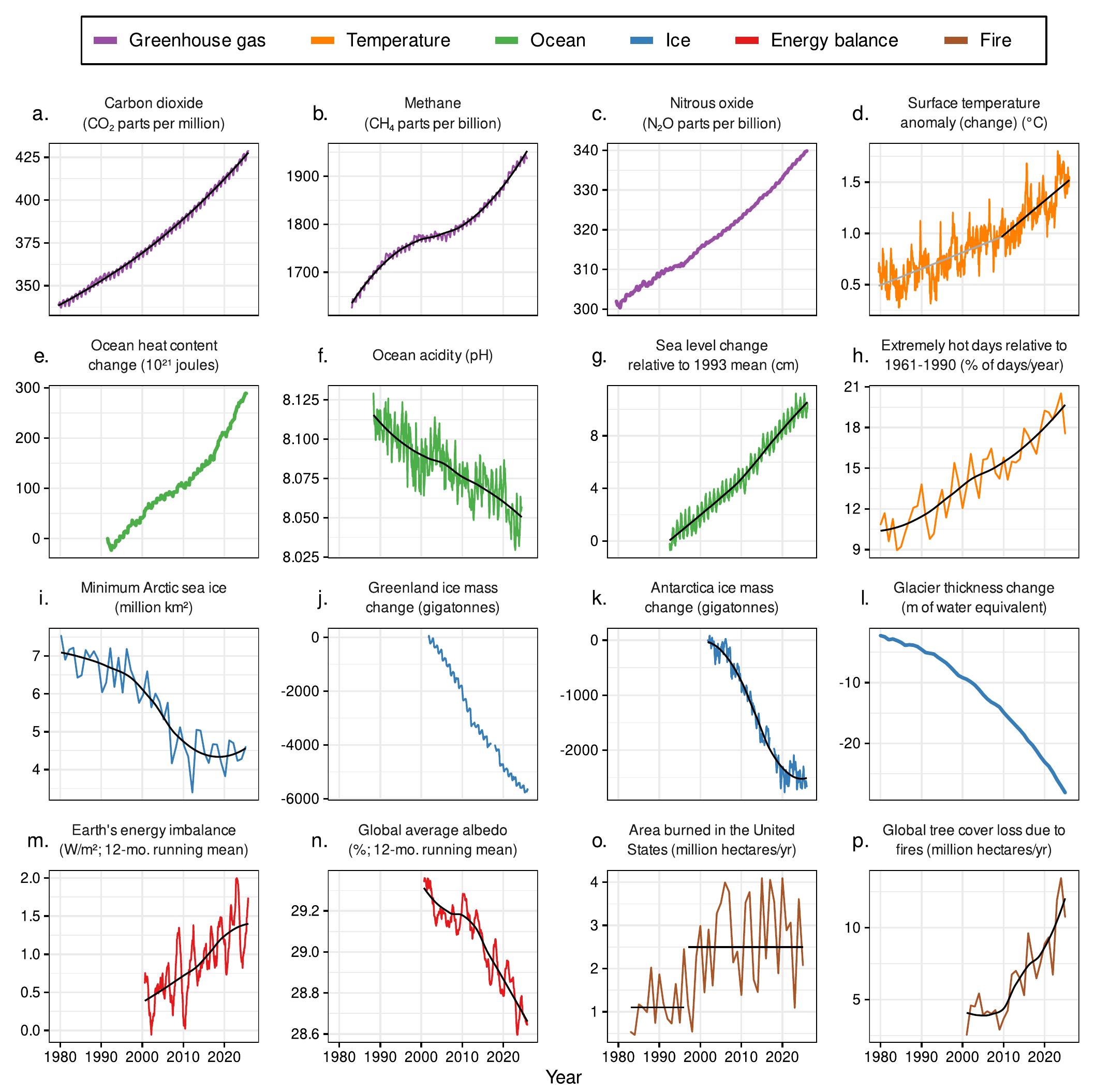
Of 16 planetary vital signs spanning greenhouse gas concentrations, temperatures, the oceans, ice, energy balance, and wildfire, 7 (44%) are currently at record extremes, and several show evidence of acceleration or abrupt shifts (figure 1; and see table S1 for data sources and methods).
Global greenhouse gases and temperature
Based on year-to-date averages, concentrations of the three most important greenhouse gases, carbon dioxide, methane, and nitrous oxide, all reached record levels again in 2026 (figure 1a–c). In May of 2026, atmospheric CO2 concentration exceeded 428 ppm, which is ∼50% greater than pre-industrial levels (figure 1a). These rising greenhouse gas concentrations, largely generated by burning fossil fuels, continue to intensify Earth’s energy imbalance and long-term warming. The last four years have also seen numerous temperature records broken (figure S1). Beginning in early autumn of 2026, a very strong El Niño event is expected to cause substantial additional warming, putting the year on track to be one of the hottest on record (figure 1d; Hausfather 2026).
Oceans and ice
Glacier thickness and Greenland ice mass are now at record lows (figure 1i, l). In recent decades, the Greenland ice sheet has undergone a series of intense melting episodes contributing to a sixfold increase in extreme summer meltwater volume (Bonsoms et al. 2026). In addition, minimum Arctic sea ice extent and Antarctic ice mass change are also near record extremes (figure 1i, k).
The oceans continue to absorb the vast majority of excess heat generated by greenhouse gas emissions. Based on preliminary data, ocean heat content and sea level are at record highs (figure 1e, g). Ocean heat content is rising at an accelerating rate, and the resulting thermal expansion of seawater accounts for approximately 56% of the global sea level rise observed in recent decades (Liang et al. 2025). Marine heatwaves have also increased in frequency and intensity, contributing to coral bleaching, ecosystem disruption, and regional climate extremes (Wernberg et al. 2025).
Energy balance
Earth’s energy imbalance, the difference between the amount of solar energy Earth absorbs and the amount of energy it radiates back into space, characterizes heat accumulation throughout the entire climate system, making it one of the most comprehensive indicators of climate change (WMO 2026). An increasing energy imbalance means that more heat is accumulating throughout the climate system, contributing to rising air temperatures, ocean warming, sea-level rise, and more frequent and intense extreme weather events. The recent rise in the energy imbalance may be partly due to a cloud-related reduction in albedo (figure 1m), potentially linked to aerosol-cloud interactions (Goessling et al. 2025). However, other work argues that it may be fundamentally tied to circulation changes associated with El Niño (Zhang et al. 2026), or connected to a weakening of the global carbon sink on land (Ke et al. 2024).
Wildfires
Global tree cover loss due to fires was 10.8 million hectares in 2025, its third-highest level on record (figure 1p). Global forest fire carbon emissions have increased substantially in recent years, largely due to trends in extratropical regions where fire activity is strongly influenced by climate (Jones et al. 2024). Increasing wildfire activity is both a consequence of climate change and a growing source of greenhouse gas emissions creating a positive feedback loop that further amplifies global warming (Liu et al. 2014), with severe implications for global biodiversity and human health (Kriit et al. 2026). These dynamics have disproportionate impacts on forest-dependent and Indigenous communities, who often have limited adaptive capacity.
The human enterprise
Human activities, including energy use, food production, economic growth, and land-use change, continue to drive many of the rapid changes occurring across the Earth system (figure 2). Global human population size reached a record high in 2026, and continues to increase by roughly 1.3 million people per week, although the rate of increase is slowing (figure 2a). As of 2024, ruminant livestock population and per capita meat production were also at a record high (figure 2d). Ruminant livestock population size is currently rising by ∼0.7 million per week. The increase in calories produced for livestock feed and non-food uses has contributed to a decline in the efficiency of the agricultural system; as of 2020, only half of the calories produced on croplands were available for direct human consumption, with beef production accounting for the largest total loss of calories during feed-to-food conversion, highlighting major inefficiencies in the global food system (West et al. 2026).
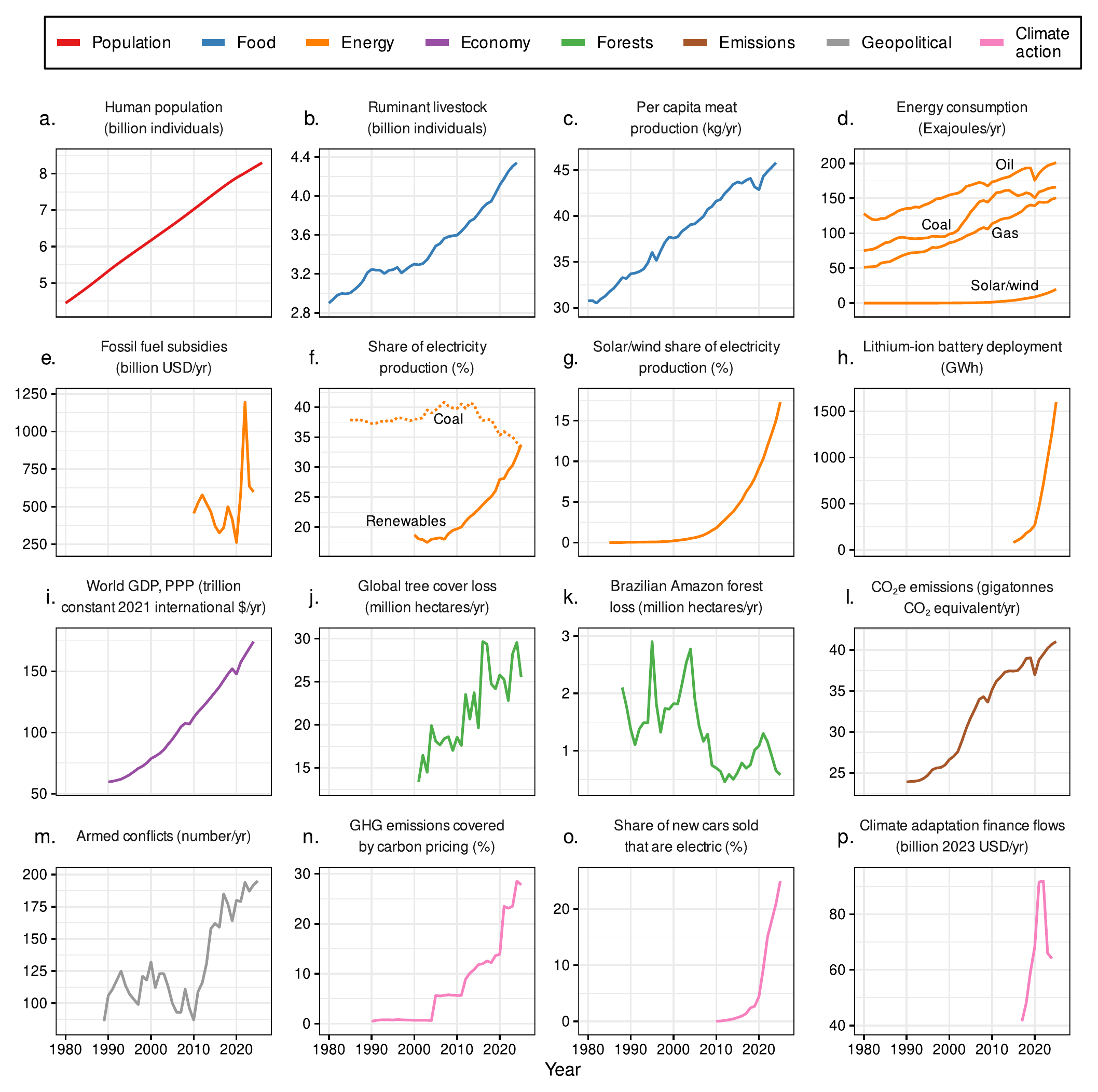
Global economic growth during the last 4 years followed a strong post-pandemic rebound, with annual growth rates averaging around 3% over this period (United Nations 2026), associated with a forecasted increase in primary energy demand of about 2% (IEA 2025a). World gross domestic product rose to an all-time high in 2024 (figure 2i). The share of new cars sold that are electric reached a record high in 2025, reflecting continued growth in the adoption of low-carbon transportation technologies (figure 2o).
Energy
Fossil fuel consumption increased by 0.9% in 2025, with oil (+1.0%), coal (+0.4%), and gas (+1.3%) all reaching record highs (figure 2d). There was also a rise in annual energy-related CO2 emissions, which surpassed 41 Gt for the first time (figure 2l). Also in 2025, solar and wind energy consumption increased by approximately 18% (figure 2d). Although this growth was rapid, renewables still represented a much smaller share of total energy consumption than fossil fuels. Continued growth in global energy demand meant that renewable expansion was insufficient to displace fossil fuel consumption, resulting in record levels of both fossil fuel use and CO2 emissions. As of 2024, more than 90% of new utility-scale renewable projects provide electricity more cheaply than the least expensive new fossil fuel power alternatives (IRENA 2025). In 2025, for the first time in more than a century of coal-dominated electricity generation, renewable energy sources (solar, wind, hydropower, and other renewables) have surpassed coal globally, marking a potentially historic turning point in the transition toward clean energy (figure S2, figure 2f). […]
Forests
Tropical primary forest loss decreased by 36% in 2025 compared to 2024 (Goldman et al. 2026). The deforestation rate in the Brazilian Amazon rainforest decreased for the fourth straight year in a row, reaching its third lowest level in 38 years (figure 2k). Globally, tree cover loss rate also declined in 2025, but remains at its sixth-highest level since 2001 (figure 2j). At the same time, conversion of native grasslands, savannas, and other non-forest ecosystems continues to contribute substantially to biodiversity loss and greenhouse gas emissions, despite receiving less attention than deforestation. Furthermore, the land carbon sink may be weaker than previously believed, in which case the land biosphere could be closer to transitioning to a net carbon source than predicted by current models (Randerson et al. 2025). Record heat is increasing carbon dioxide released by plants, soils, and other living organisms, a trend likely to become more pronounced under future climate change and further reinforce global warming (Dong et al. 2026).
Escalating risks
Beyond gradual climatic change, growing evidence suggests that the climate system may be entering a period of increasing instability characterized by accelerating warming, cascading feedbacks, tipping elements, and rising risks of irreversible change. Increasing energy imbalance, rising ocean heat content, weakening carbon sinks, and accelerating ice loss all point toward a climate system accumulating heat and stress at rates that may exceed earlier expectations. Extreme weather is also intensifying across many regions of the world, demonstrating how climate change is increasingly affecting people’s daily lives (table 1). Recent years have brought increasingly destructive heatwaves, floods, droughts, storms, and wildfires that are causing growing losses of life, infrastructure, food security, biodiversity, and economic stability. Extreme weather disasters are complex phenomena that arise from the interaction between climatic hazards and human social systems, rather than from climatic hazards alone. They are shaped by differences in social conditions that determine who faces the greatest risks and vulnerabilities (Kelman et al. 2015).
The past year has demonstrated the growing human and economic toll of extreme weather events worldwide (table 1). In October 2025, Hurricane Melissa, one of the strongest Atlantic hurricanes on record, caused 95 deaths and more than US$12 billion in damages across the Caribbean. Severe flooding also affected multiple regions, including Indonesia in November 2025, where a tropical storm and monsoon rains caused 708 deaths and widespread infrastructure damage, and Vietnam in November 2025, where record rainfall killed 90 people and inundated 235,000 homes. Extreme heat also remained a major concern; in June 2026, a severe heatwave in Europe caused approximately 14,000 deaths according to a preliminary estimate (Callahan 2026). All of these events were at least partly attributable to climate change (see table S2 for associated attribution studies).
The rate of global warming appears to have accelerated, rising from ∼0.05°C/decade between 1880 and 1970 to ∼0.19°C/decade between 1970 and 2010, and finally to ∼0.36°C/decade between 2010 and 2024 (figure 3). A similar acceleration has been found to be statistically significant since roughly 2015 (Foster and Rahmstorf 2026). The acceleration may be partly related to reductions in aerosol pollutants that previously masked a portion of greenhouse gas warming (Hansen et al. 2025). Faster warming could compress adaptation timelines, increase the likelihood of crossing tipping thresholds, and reduce the margin for avoiding irreversible impacts. On the other hand, other analyses find that the observed warming, including the 2023–2024 global temperature spike, is consistent with state-of-the-art climate model simulations (Mann et al. 2026). Even if warming is closely tracking model projections, key impacts such as the rise in extreme weather events may not be well captured by the models (Li et al. 2025).
Growing concern also surrounds the destabilization of climate tipping elements. The Atlantic Meridional Overturning Circulation (AMOC), which transports warm water northward and cold water southward, may be particularly important because of its interactions with other tipping elements (Wunderling et al. 2024). Melting of Arctic sea ice and the Greenland ice sheet may weaken the AMOC, which could alter precipitation patterns, disrupt marine ecosystems, and increase drying in parts of the Amazon rainforest. Observational constraints project that the AMOC could weaken substantially, potentially more than projected by many current climate models (Portmann et al. 2026). In addition, after accounting for multiple planetary-boundary transgressions, the Amazon rainforest may be more vulnerable to tipping than previously recognized. Although the forest may remain resilient to climate warming alone up to 3°C–5°C, the combined effects of warming and deforestation could push it past an irreversible threshold at just 1.5°C–1.9°C of warming (Wunderling et al. 2026).
Globally, recent estimates suggest that amplifying climate feedbacks involving warming-induced greenhouse gas emissions from natural sources including permafrost, wetlands, freshwaters, and wildfire could increase post-2020 anthropogenic warming by roughly 20%–30% by 2100 (Abernethy et al. 2026). Continued warming and interacting feedbacks may increase the risk of a self-reinforcing “hothouse” trajectory characterized by weakening carbon sinks, accelerating ice loss, ecosystem degradation, and additional greenhouse gas release (Ripple et al. 2026). Although substantial uncertainties remain, recent observations suggest that some climate-system changes may already be unfolding faster than expected. […]
Final words
Despite escalating climate risks, signs of societal transformation are beginning to emerge. Rapid advances in renewable energy, battery storage, adaptation planning, ecosystem restoration, and climate response tools suggest that large-scale change remains possible. The 2026 Santa Marta conference in Colombia marked an important milestone as the first global summit dedicated exclusively to the practical phase-out of fossil fuels. The meeting established a new international precedent for transitioning away from coal, oil, and gas, involving more than 50 participating nations and 24 formal signatory countries. Although current progress remains far below what is needed to stabilize the climate system, the future trajectory of both the climate system and human societies has not yet been fully determined. The decisions made during the coming years will strongly influence whether future generations inherit a planet with an unstable climate system or a more resilient and sustainable world. [more]
The 2026 state of the climate report: challenges and opportunities