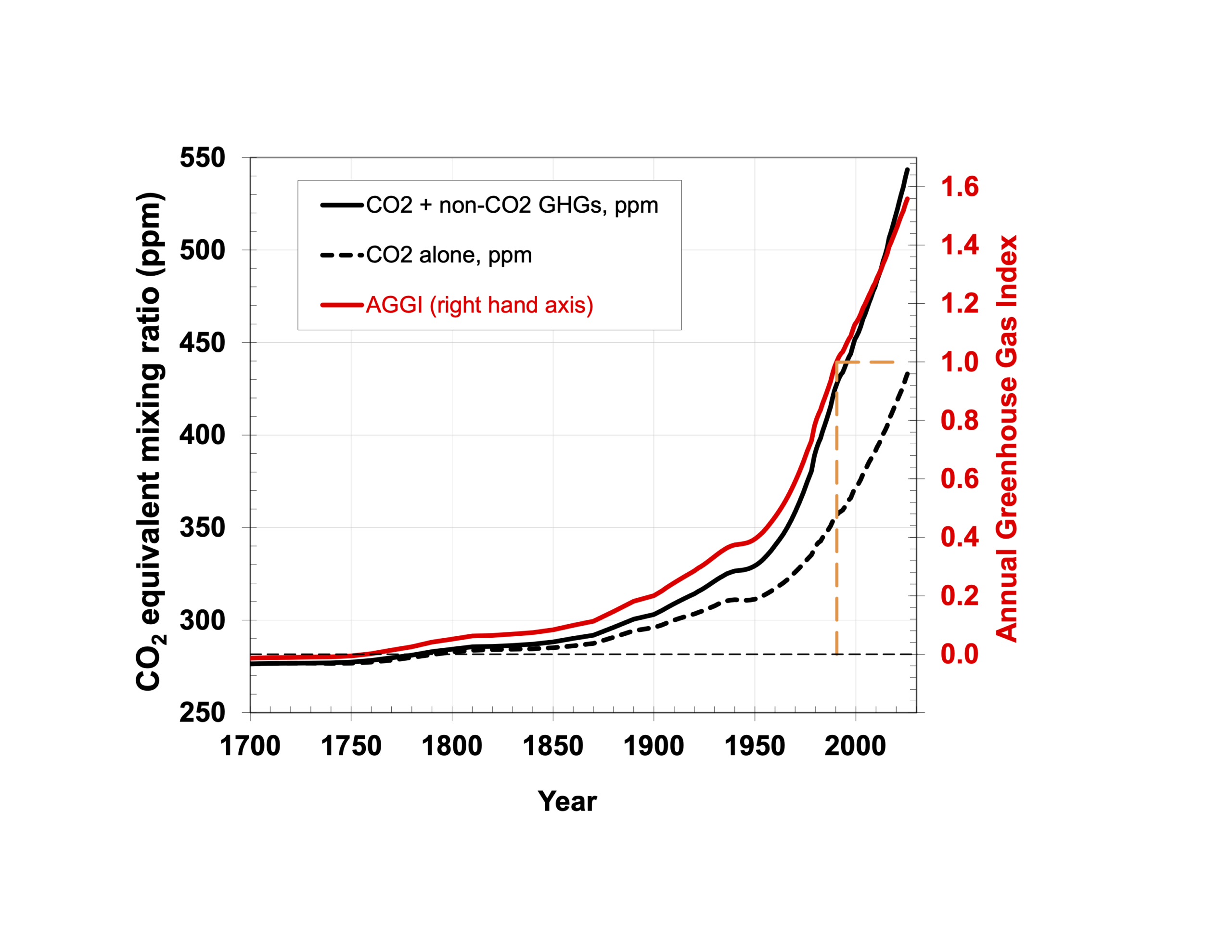
Annual Greenhouse Gas Index (AGGI), 1700-2025. For 2025, the AGGI was a record high 1.56, representing a 56 percent increase in effective radiative forcing from long-lived greenhouse gases since 1990. Time series since 1700 for atmospheric CO2 abundance (black dashed line), CO2-equivalent abundance based on ongoing measurements of all greenhouse gases reported here (black line), and the AGGI (red line, right-hand scale). The measurements of CO2 between the 1950s and 1978 are from C.D. Keeling [Keeling et al., 1958]. Prior to 1978, atmospheric abundances represent values derived from air trapped in ice and snow above glaciers [Machida et al., 1995, Battle et al., 1996, Etheridge et al., 1996; Butler et al., 1999]. The dashed orange lines highlight the AGGI reference year (1990) at which the index is normalized to a value of 1.0. Graphic: NOAA Global Monitoring Laboratory

Another record high for NOAA Annual Greenhouse Gas Index in 2025 – Long-lived greenhouse gases trapped 56 percent more heat than in 1990 – Carbon dioxide reached 425.62 ppm, and its rate of increase has accelerated to 2.5 ppm per year

21 October 2026 (NOAA) – The AGGI quantifies radiative forcing from long-lived trace gases and its change over time. The index is derived from NOAA GML’s long-term measurements of greenhouse gas abundances in the remote atmosphere at sites across the globe; it is formulated to provide an understanding of the change in radiative forcing in […]

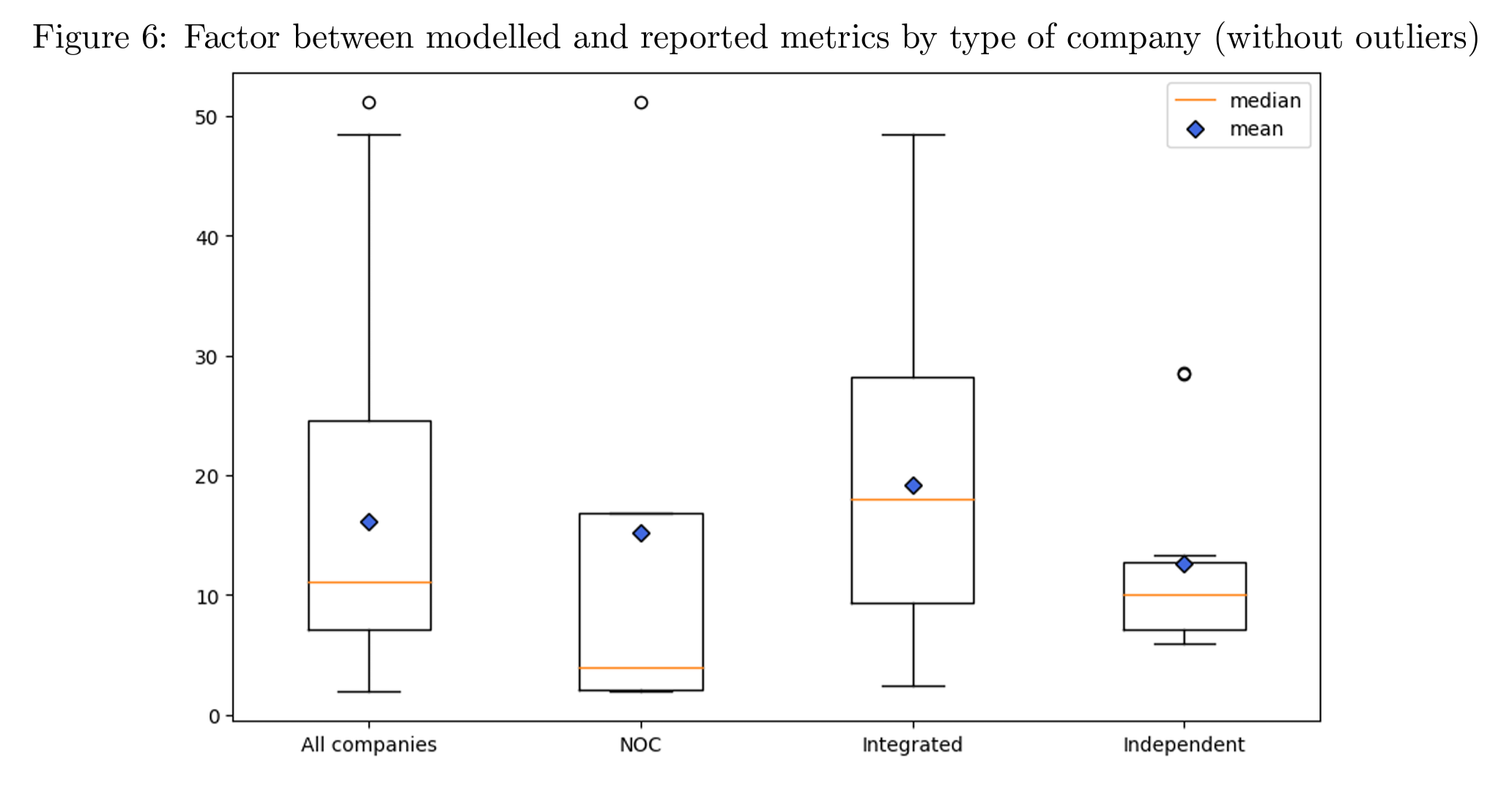
Difference between modelled and reported methane intensities by type of company. Modelled emissions are compared with the methane emissions reported by each company in its sustainability reporting or its public communication. The global average ratio on this set of companies is 16.1, with a relative standard deviation of 79.3 percent. Each type of company within this set does not contribute similarly to these global metrics. Integrated companies have the highest average ratio between model and reporting out of all the types of companies, at 19.2 and a relative standard deviation of 64.7 percent, which means that some Integrated companies reporting are much closer to the values for their corresponding model than others. National oil companies (NOCs) have the lowest median ratio with 4.0 but their average is the second highest at 15.2, strongly influenced by one of the companies in the category that has a factor of 51.2, while the remaining 4 have an average of 6.2. Independent companies have the lowest average with 12.6 and a relative standard deviation of 65.2 percent, which shows the importance of the regions of operation in the results of different models. Graphic: Peyle, et al., 2024

We used satellite imagery and AI to see who’s keeping their climate pledges – Almost none of the signatories of the Global Methane Pledge are following through on their commitment – On average, companies emit methane intensities 16 times larger than reported

By Antoine Rostand 17 July 2024 (Fortune) – Committing countries or companies to climate pledges doesn’t guarantee that those pledges will be honored. After all, the planet is getting a great deal hotter every year, with the record-breaking temperature in India in May just the latest example. If companies and countries were fully honoring their […]

Trump walks onstage to deliver the keynote address at the Faith & Freedom Coalition’s Road to Majority Policy Conference at the Washington Hilton on 22 June 2024 in Washington, D.C. Photo: Samuel Corum / Getty Images

What Trump allies’ Project 2025 would mean for the fight against climate change – “Trump would frack the National Mall if he thought it would make a couple of bucks for donors and Big Oil”

By Zack Budryk and Rachel Frazin 13 July 2025 (The Hill) – Project 2025, a controversial conservative roadmap that aims to guide the next Republican administration, calls for the elimination of multiple energy- and environment-related offices and rules — moves that would restrict the government’s ability to combat climate change and pollution. Policies promoted under the plan […]

James M. Inhofe during a Senate hearing in 2009. The Senate Environment Committee gave him a prominent platform from which to speak out against growing scientific consensus that humans were causing climate change by burning fossil fuels. Photo: Scott J. Ferrell / Congressional Quarterly / Getty Images

James M. Inhofe, Senator who denied climate change, dies at 89

By Robert D. McFadden 9 July 2024 (The New York Times) – James M. Inhofe, a five-term Republican senator from Oklahoma and, until President Donald J. Trump’s arrival in 2017, arguably Washington’s most prominent denier of the established science of human-generated climate change, died on Tuesday. He was 89. His family announced his death in […]

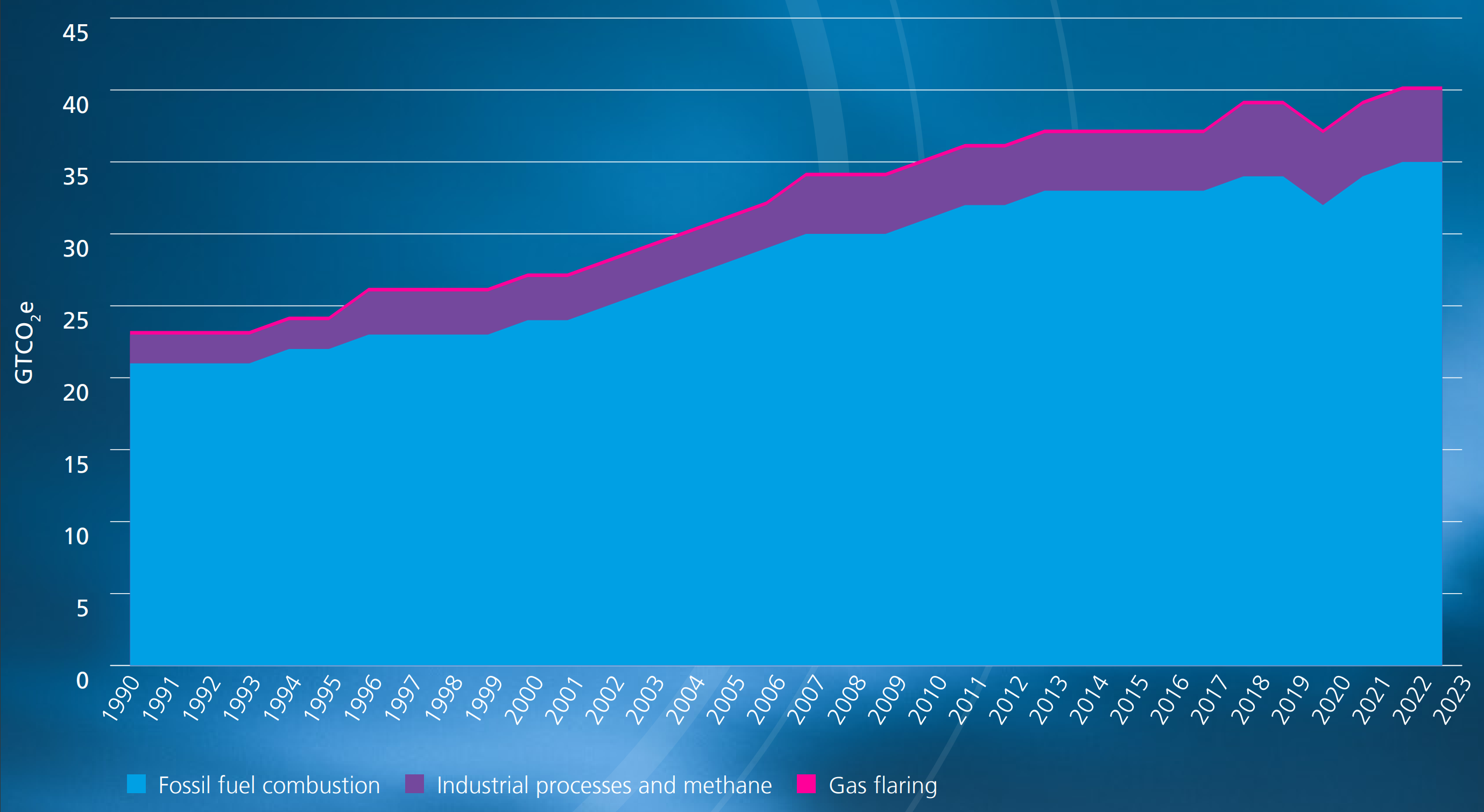
Global energy-related greenhouse gas emissions in GTCO2e, 1990-2023. In 2023, global energy-related greenhouse gas emissions exceeded 40 gigatonnes for the first time ever. Graphic: Energy Institute

World energy report reveals 2023 was a year of record highs in an energy-hungry world – “In a year where we have seen the contribution of renewables reaching a new record high, ever increasing global energy demand means the share coming from fossil fuels has remained virtually unchanged at just over 80 percent for yet another year”

20 June 2024 (Energy Institute) – The Energy Institute (EI) and co-authors KPMG and Kearney today released the 73rd annual edition of the Statistical Review of World Energy, presenting for the first time full global energy data for 2023. Five key stories emerge from the 2023 data: EI President Juliet Davenport OBE HonFEI said: “Energy is central […]

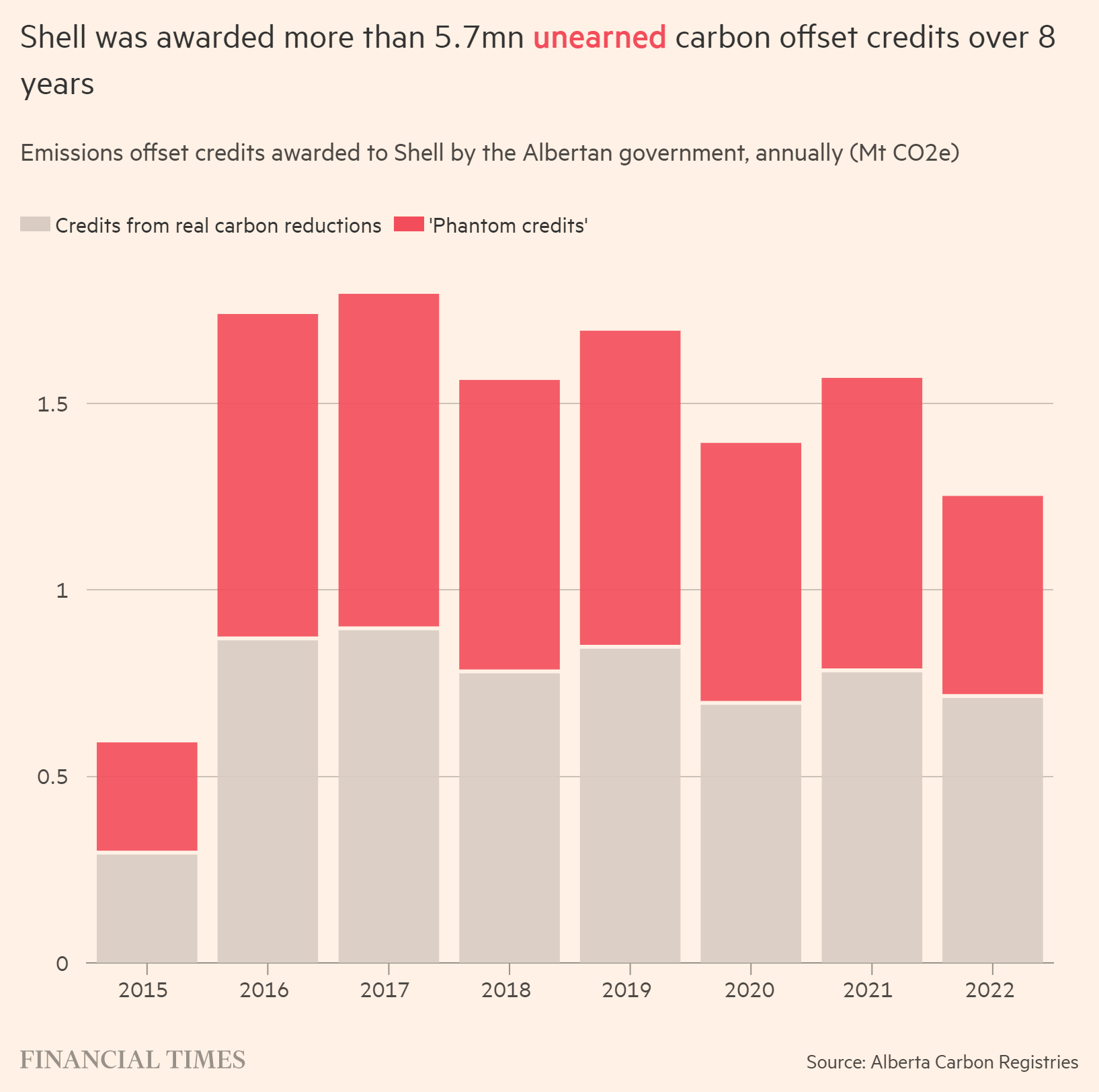
Emissions offset credits awarded to Shell by the Albertan government (Mt CO2e), 2015-2022. Shell was awarded more than 5.7 million unearned carbon offset credits over 8 years. Data: Alberta Carbon Registries. Graphic: Financial Times

Shell plant reported millions of “phantom” carbon credits – “Selling emissions credits for reductions that never happened literally makes climate change worse”

By Kenza Bryan and Clara Murray 4 May 2024 LONDON (Financial Times) – A Shell-operated plant reported millions of carbon credits tied to CO₂ removal that never took place but were used by Canada’s largest oil sands companies, raising new doubts about a technology seen as crucial to mitigating greenhouse gas emissions. As part of […]

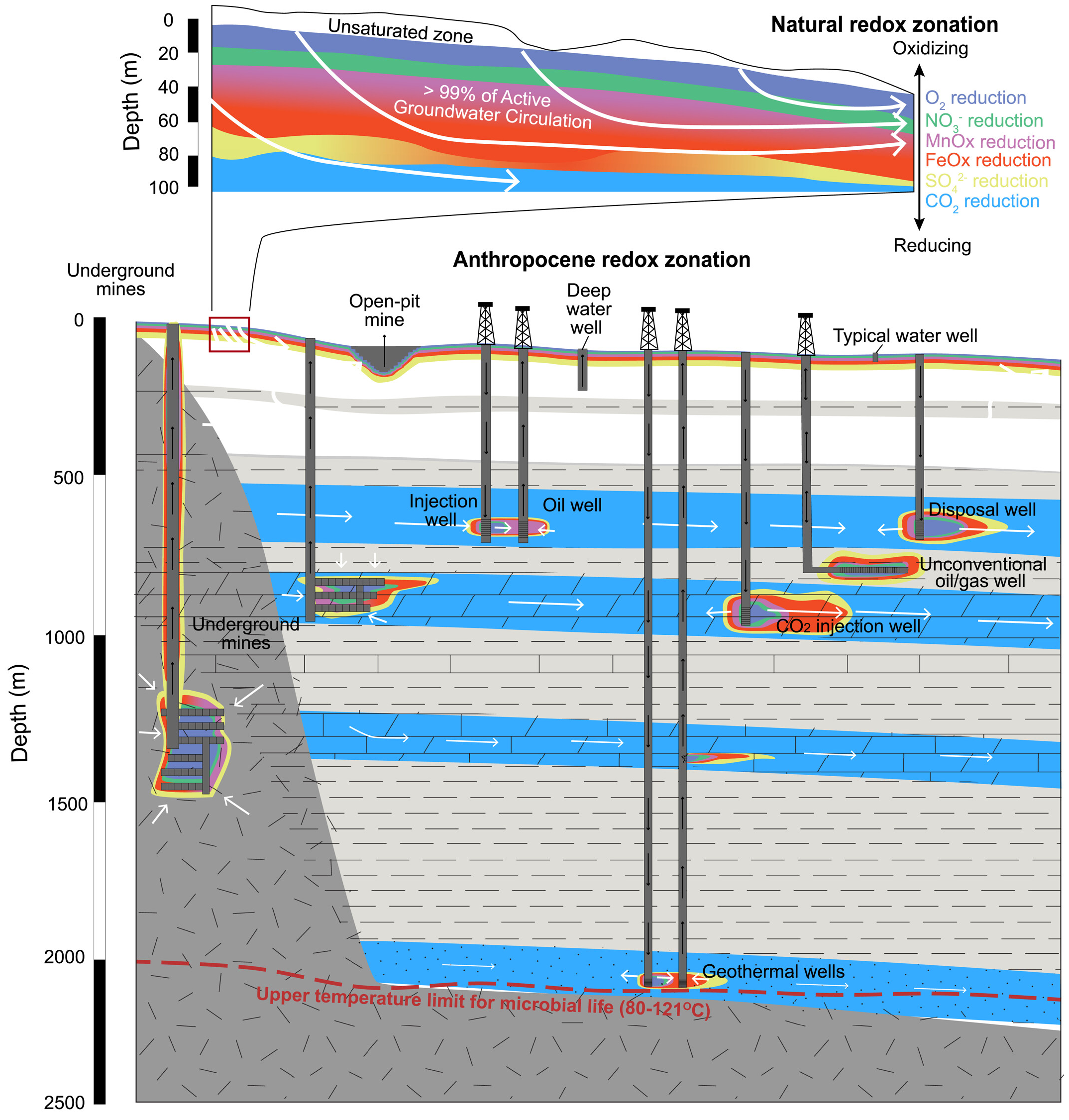
Approximate depths of subsurface activities. Median (31 m) and 95th (130 m) percentile of water wells (Jasechko & Perrone, 2021); minimum depth of CCS in sedimentary basins (800 m) (Benson & Cole, 2008); shallow limit of oil and gas development (including injection and disposal; 600 m) (Lemay, 2008); geothermal (>2,000 m) (Nardini, 2022). The upper temperature limit for life (80–121°C) (Bar-On et al., 2018; Magnabosco et al., 2018) approximately corresponds to the lowest temperatures required for geothermal power generation (Nardini, 2022; Tester et al., 2021). Circulation of meteoric water occurs up to depths of a few km (McIntosh & Ferguson, 2021) but fluxes are small below 500 m and residence times range from tens of thousands to millions of years (Ferguson et al., 2023; Jasechko et al., 2017; Warr et al., 2021). Graphic: Ferguson, et al., 2024 / Earth’s Future

Human activities have an intense impact on Earth’s deep subsurface fluid flow – “We know more about the surface of Mars than we do about water, rocks, and life deep beneath our feet”

By Niranjana Rajalakshmi 23 April 2024 (University of Arizona) – The impact of human activities – such as greenhouse gas emissions and deforestation – on Earth’s surface have been well-studied. Now, hydrology researchers from the University of Arizona have investigated how humans impact Earth’s deep subsurface, a zone that lies hundreds of meters to several […]

Electric vehicles charging in Victorville, California, 11 March 2024. In California, electric vehicles could soon account for 10 percent of peak power demand. Photo: Lauren Justice / The New York Times

A new surge in power use is threatening U.S. climate goals – “I can’t recall the last time I was so alarmed about the country’s energy trajectory”

By Brad Plumer 17 March 2024 (The New York Times) – Something unusual is happening in America. Demand for electricity, which has stayed largely flat for two decades, has begun to surge. Over the past year, electric utilities have nearly doubled their forecasts of how much additional power they’ll need by 2028 as they confront […]

Haitham Al-Ghais, the secretary general of OPEC, warned member countries of “undue and disproportionate pressure against fossil fuels” at the COP28 summit In a letter dated 6 December 2023. Photo: Amr Abdallah Dalsh / Reuters

OPEC leader tells members to block any COP28 climate summit deal to curb fossil fuels – “Reject any text or formula that targets energy i.e. fossil fuels rather than emissions”

By Lisa Friedman 8 December 2023 (The New York Times) – The head of the OPEC oil cartel, alarmed that nations gathered at the United Nations climate summit in Dubai are considering an agreement to phase out fossil fuels, has directed the group’s members to scuttle any deal that would affect the continued production and […]

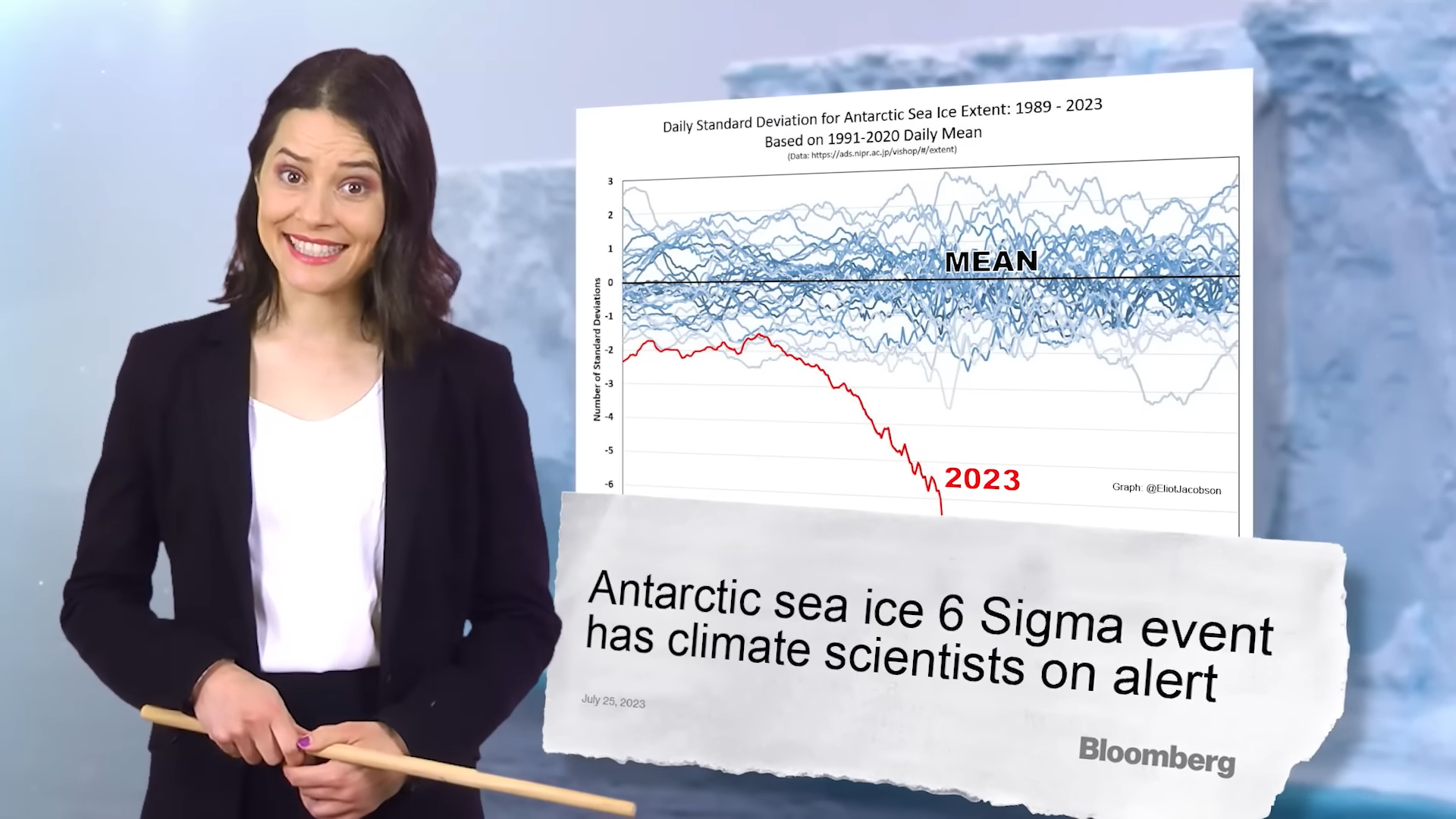
Screenshot from “Honest Government Ad: COP31 🇦🇺 & the Pacific”, by The Juice Media, showing the rapid, record-breaking decline of Antarctic sea ice in 2023. Photo: The Juice Media

Video: Honest Government Ad: COP31 🇦🇺 and the Pacific – “Let this major fossil-fuel exporter that’s cockblocked climate action for decades co-host a crucial summit with the most climate-vulnerable nations in the world while ignoring their pleas to stop harming them”

1 August 2023 (The Juice Media) – Hello. Bonjour. Ciao stronzi. Namaste. Ham maadarachod hain. I’m from the Australien Government with a message to the world. As cities bake, fires rage, reefs die, jet streams weaken, and 6-Ligma events cause climate scientists to shit their dacks, many are wondering if we’ve finally broken our favourite […]
Social media & sharing icons powered by UltimatelySocial