U.S. loses measles elimination status, along with Mexico and Bolivia – Upward of 5,400 U.S. cases in 2026, the highest since 1991, and ten deaths – “The lack of action to address the growing outbreak is clear negligence”
By Aria Bendix
17 November 2026 (NBC News) – Measles is no longer eliminated in the United States, reversing one of the country’s greatest public health achievements this century.
An independent commission of the Pan American Health Organization (PAHO), a group within the World Health Organization, revoked the U.S.’ measles-elimination status after determining that the virus has circulated nonstop for more than a year. PAHO announced the decision Tuesday.
“Losing a measles elimination status has broader implications than losing a public health designation,” PAHO’s director, Dr. Jarbas Barbosa, said in a media briefing. “It means the virus has circulated for a prolonged period of time, putting families and communities at risk of a preventable illness, hospitalization and death.”
The U.S. earned the elimination status in 2000. Now, measles is once again endemic.
“As a pediatrician and a parent, I am heartbroken that we have reached this point,” said Dr. Richard Besser, president of the Robert Wood Johnson Foundation, a health-focused philanthropic organization. “Too many families in America are once again having to worry that their children could get this preventable infection and suffer its most severe consequences.”
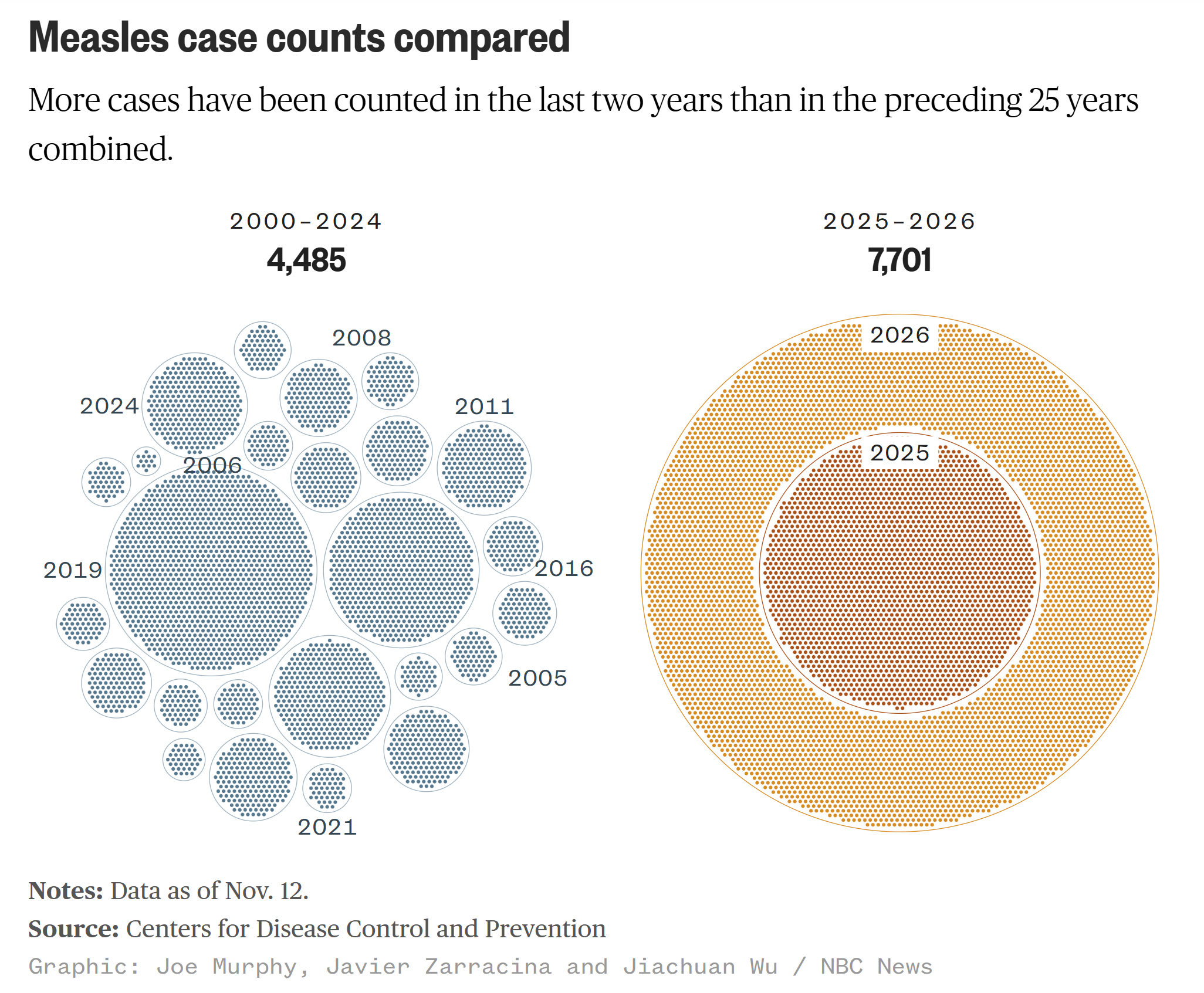
Upward of 5,400 cases have been recorded this year — more than double last year’s count and the highest since 1991. Ten people have died, according to state health departments.
PAHO determines whether countries in the Americas meet the requirements for measles elimination. The group deliberated for four days last week in Washington, D.C., to assess whether transmission in the U.S. and other countries in the region had been sustained from January 2025 to January 2026. In addition to the U.S., the group determined that measles is no longer eliminated in Mexico or Bolivia.
A commission made up of eight public health experts evaluated genetic data from “homegrown” cases (those not related to international travel) to figure out whether outbreaks across U.S. states were linked. The commission also weighed levels of vaccination coverage, the quality of measles surveillance and whether there are sufficient strategies and resources to respond to outbreaks.
As in many countries, vaccination rates in the U.S. have declined in recent years: 92 percent of kindergartners had been vaccinated for measles as of the 2025-26 school year, down from 95 percent — the threshold needed to prevent outbreaks — in the 2019-20 school year.
Nationwide among kindergartners, 75 percent of counties and jurisdictions with measles vaccine data fall below the 95 percent rate, according to an NBC News investigation.
“The United States has an extraordinary measles problem. We’ve had more measles cases in the last 18 months than we’ve had in the previous 25 years combined,” said Noel Brewer, a public health professor at the University of North Carolina at Chapel Hill.
Endemic measles poses a serious risk to people who are unvaccinated, said Dr. Walter Orenstein, former director of the U.S. immunization program at the Centers for Disease Control and Prevention. The risk is especially pronounced for infants, who are not typically eligible for the first dose of the vaccine until they turn 1, as well as those who cannot get the shot because they are immunocompromised.
“People can go into a supermarket and get infected,” he said.
At least four of the measles deaths this year were in babies too young to be vaccinated. […]
Brewer said the U.S. desperately needs a strategy for tackling measles.
“The lack of action to address the growing outbreak is clear negligence,” he said.
Under past presidential administrations, the CDC has responded to measles outbreaks with media briefings and vaccination campaigns, but the agency has not done so this year. […]
Since taking office, [Health Secretary Robert F. Kennedy Jr.] has questioned the safety and effectiveness of measles vaccines and touted unproven remedies like inhaled steroids. President Donald Trump, meanwhile, falsely suggested in August that the combined measles shot could be “quite lethal,” despite decades of evidence demonstrating its safety.
“We have seen frequent and damaging public comments that have been shaking the confidence of parents about vaccination,” Brewer said. […]
Last year, Canada’s measles elimination status was revoked following an outbreak that led to more than 5,000 cases. […]
Barbosa, PAHO’s director, said Tuesday that Canada has interrupted measles transmission in its outbreak but that the country needs to keep up with vaccinations and surveillance to reclaim its elimination status.
It could take years, experts said, for the U.S. to do the same. [more]
U.S. loses measles-elimination status, erasing decades of progress
17 November 2026 (PAHO) – The Pan American Health Organization (PAHO) today called on countries across the Americas to intensify efforts to stop measles transmission, close vaccination gaps, and put the Region back on track towards elimination, as outbreaks continue to spread in several parts of the Americas.
The call follows the 10–13 November meeting of the Measles, Rubella and Congenital Rubella Syndrome Elimination Regional Monitoring and Re-Verification Commission (RVC), which reviewed the latest epidemiological situation across the Region. Following the Commission’s assessment and recommendations, which were accepted by PAHO Director Dr. Jarbas Barbosa, endemic measles transmission was determined to have been re-established in Bolivia, Mexico, and the United States. All three countries have therefore lost their measles elimination status.
Under the Commission’s criteria, endemic transmission is considered re-established when the same measles virus genotype and lineage circulate uninterrupted for 12 months or more in a country.
“Losing measles elimination status is much more than losing a public health designation. It means the virus has circulated for a prolonged period, putting families and communities at risk of preventable illness, hospitalization and death,” said Dr. Barbosa.
The Region of the Americas, the first in the world to eliminate measles, regained its elimination status in 2024 after successfully interrupting endemic transmission in Venezuela and Brazil. However, the loss of regional status in November 2025, following sustained transmission in Canada, was a major setback. The subsequent loss of elimination status by Bolivia, Mexico and the United States marks a further deterioration in the regional situation and makes the path towards restoring elimination more challenging.
“This is a serious warning for our Region, but it is not an irreversible setback,” added the PAHO Director. “We know how to prevent measles, and we know how to stop its transmission. With sustained commitment to vaccination, strong surveillance and effective outbreak response, the Americas can eliminate measles transmission once again.”
Current situation
As of 13 November 2026, the Region has reported 58,213 confirmed measles cases and 82 deaths, compared with 12,806 cases during the same period last year.
Bolivia, Mexico and the United States have lost their status after the same measles virus lineage circulated uninterrupted for 12 months or more. All three countries are implementing measures to strengthen vaccination, surveillance and outbreak response. Meanwhile, Canada has interrupted the chain of transmission associated with the outbreak that led to its loss of status and is working to regain elimination status.
Measles is one of the most contagious diseases in the world: one infected person can transmit the virus to as many as 18 susceptible individuals. It can cause serious complications, including pneumonia, encephalitis and blindness, and can lead to death. Infection can also weaken the immune system for months afterwards.
The resurgence of measles across the Region reflects persistent gaps in population immunity, often concentrated in particular communities and geographic areas. National vaccination figures can mask these disparities, while barriers to health services, missed vaccinations, misinformation and vaccine hesitancy leave children, adolescents and adults vulnerable to infection.
Measles is resurging globally amid persistent gaps in vaccination coverage, and several other countries in the Americas are also experiencing prolonged outbreaks. “This situation requires urgent action,” said the PAHO Director. “Continued transmission anywhere increases the risk of the virus reaching people who cannot be vaccinated and communities where immunity gaps persist.”
Protecting those who cannot be vaccinated for medical reasons, as well as babies who are too young to receive the vaccine, depends on ensuring that the people around them are protected.
PAHO’s response and RVC recommendations
PAHO is working with countries to interrupt measles transmission through vaccination campaigns, stronger epidemiological and laboratory surveillance, rapid-response teams and support for outbreak investigation and containment. […]
Sustaining at least 95 percent coverage with both doses of the measles vaccine in every community remains essential to closing immunity gaps and preventing further transmission. National averages can mask pockets of low coverage, making it critical to reach every community, particularly those most vulnerable to outbreaks.
The path back to elimination
The Americas has faced this challenge before. After endemic transmission was re-established in Venezuela and Brazil in 2018 and 2019, respectively, countries worked together to interrupt transmission, and the Region regained its measles elimination status in 2024.
“Elimination is not a trophy that we win once and put on a shelf. It must be protected every day by closing immunity gaps and ensuring that every community is reached,” underscored Dr. Barbosa.
Achieving and sustaining at least 95 percent coverage with both doses of the measles vaccine in every community, backed by strong surveillance and effective outbreak response, remains the path towards measles elimination.
“PAHO will continue working with every country toward that goal. We know what works. We have done it before. And with sustained commitment and action, the Americas can eliminate measles transmission once again.” [more]