COP31 summit ends with no deal after every mention of fossil fuels is removed from draft text – Longest COP in history is the first to fail since Copenhagen in 2009 – “There may be no consensus in the negotiating room. There is no ambiguity in the science.”
By Fiona Harvey, Graham Readfearn, Damien Gayle, Gabrielle Canon, and Oliver Milman
19 November 2026 (The Guardian) – Every mention of fossil fuels has been expunged from the draft outcome of global climate talks, which were approaching their final hours on Thursday night, threatening to turn the UN summit into what campaigners called a “ghost Cop”.
The second draft of the key text, released on Thursday afternoon and setting out the main commitments from the Cop31 climate summit in Turkey, removed a pledge to phase out fossil fuels and weakened goals on electrification, while other parallel texts failed to flesh out how developing countries would receive the financial help they needed to deal with the climate crisis.
Panama made the unusual move of writing to the Turkish and Australian presidents of the talks announcing that unless all its demands were met, it would block any outcome.
“We have listened carefully to the speeches of these days,” read the letter signed by Panama’s environment minister, Juan Carlos Navarro. “They are beautiful speeches. But while we listen to endless oratory, the planet is being destroyed … Outside this room and this conference, the world needs and expects radical change from us, and we are not delivering it.”
Cop negotiations require consensus, meaning that Panama’s stance, especially if supported by others, has the potential to upend the talks in their final hours. […]
But in slimming down by half an unwieldy 18-page first draft issued on Monday, the joint presidencies of Australia and Turkey cut many of the commitments – including a phaseout of fossil fuels, and stronger support for developing countries to adapt to extreme weather – that vulnerable countries were relying on.
Countries agreed to transition away from fossil fuels at Cop28 in 2023, but negotiations since have failed to flesh out the ambition.
“Frontline communities will look on with despair,” said Mohamed Adow, director of the Power Shift Africa thinktank. “If this version of the text remains, it will be a ghost Cop. The summit will have nothing to show for what happened here.”
His verdict – that the talks had been “muzzled” by the refusal of some fossil fuel producing countries to allow a commitment to “transition away from fossil fuels” to stand – was echoed by campaigners around the world. […]
Campaigners urged developing countries to reject the new drafts and keep fighting for a better outcome. “We are on the brink of an outrageous and utterly embarrassing lack of leadership by the Cop31 presidencies,” said Andreas Sieber, of the campaign group 350.org. “They have reduced one of the defining challenges of our time to an inconvenient paragraph they would rather delete.
“Rich countries’ failure on finance [for poorer nations] is a historic disgrace. They expect developing countries to shoulder the cost of a global transition while refusing to provide the means to deliver it. This is not a failure of technical negotiations. It is a shameless abdication of political responsibility.”
Chris Bowen, Australia’s climate and energy minister and president of the negotiations, laid the blame for the weak text firmly at the door of the countries present. “We have put forward what we think, based on all our consultations, gives us the best chance of the most ambitious results that consensus will allow,” he said.
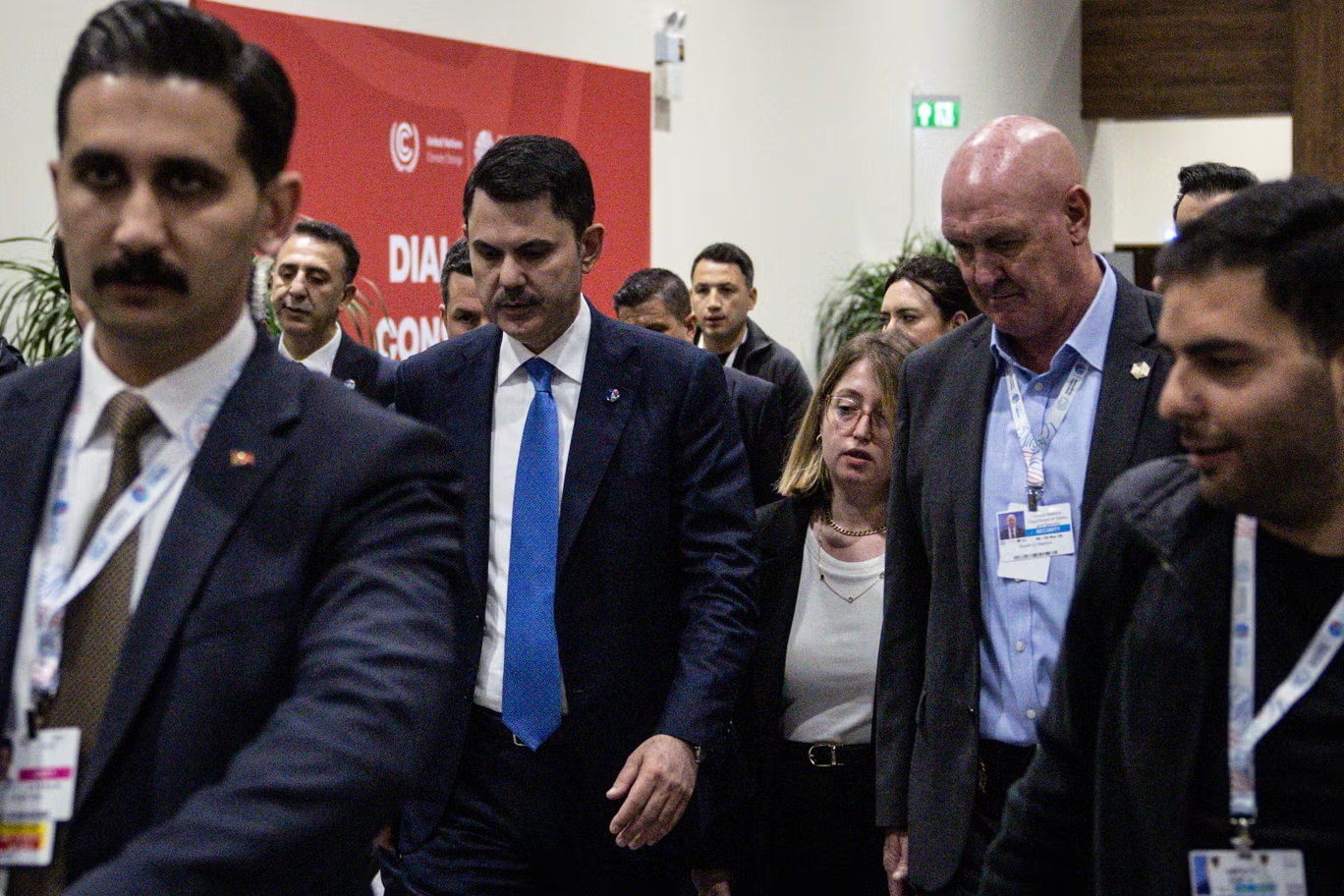
His Turkish counterpart, Murat Kurum, the president of the conference, said there was “great enthusiasm” among the countries negotiating, and that the latest text showed a “strong commitment to the Paris agreement”.
He defended the exclusion of the words “fossil fuels” by saying it had been agreed at previous Cops. “I don’t think there’s any backsliding,” he said.
The commitment to “transition away from fossil fuels” was exchanged in the text for the much weaker pledge to an “irreversible global transition towards low greenhouse gas emissions and climate resilience”, though there was reaffirmation that the goal of holding global temperature rises to 1.5C above preindustrial levels would remain central – even though it is now certain to be breached.
The pledge that 35 percent of global final energy demand should be met by electricity from 2035 was downgraded to a voluntary option among a suite of measures.
In a packed afternoon on the penultimate official day of the fortnight-long talks, a separate negotiating strand on climate finance produced a largely empty document, showing nations had failed to make progress on delivering the $300bn a year developed countries have pledged to the developing world by 2035.
Separately, at a historic leaders’ summit in Shenzhen between China, the US and Russia, Xi Jinping, Donald Trump and Vladimir Putin vowed to “increase the production and supply of refined petroleum products for the benefit of all nations”. Tlou Ramaru of the African Group of Negotiators described this as “hypocrisy”. […] [more]
Cop31 told it risks being ‘ghost’ summit as all mentions of fossil fuels removed from draft text
By Stuti Mishra and Nicole Wootton-Cane
22 November 2026 (The Independent) – The Cop31 climate summit in Turkey descended into disarray and disappointment after countries were unable to reach consensus on a deal that failed to mention fossil fuels.
Nations rejected the agreement at a fraught closing session in Antalya on Sunday, almost two days after the summit was due to finish in what stretched to become the longest Cop in history.
The European Union and nations including Panama refused to accept the text over the absence of fossil fuels, blasting the omissions as “greenwashing” and accusing oil states of “hijacking” the talks.
Ireland’s minister for climate Darragh O’Brien, speaking on behalf of the EU, called the text “unconscionable” and said its ambition went “nowhere near the level of action that’s required to deal with climate change”.
Some nations indicated a willingness to continue working, but at the closing plenary summit president Murat Kurum said there would be no new draft of the deal. […]
The failed deal had acknowledged the planet’s projected temperature overshoot for the first time and called for faster development of carbon-removal technologies to eventually reverse it.
It was already heavily criticised by small islands and civil society groups who called it a “betrayal” and criticised its reliance on carbon capture schemes, which had been pushed by oil states including Saudi Arabia.
“It seems like we are negotiating with the Saudis,” Maina Talia, Tuvalu’s climate minister, commented during the conference.
A representative for the Saudi delegation, which supported the deal’s mention of carbon removal, told the summit he was surprised at the resistance to technology, which he said offered a “concrete solution”.
Developing countries had also criticised the deal for not providing sufficient new funds to help them adapt to a warming planet.
China and India said they had objections but chose to accept the cover text to move things forward.
Earlier, Mr Kurum defended the text and said the presidencies had “listened to everyone” and tried to bring the groups together, but admitted there was “no consensus”.
Australia’s Cop31 president of negotiations, Chris Bowen, called the outcome “very disappointing” and said disagreements over fuels and climate finance were the dealbreakers.
The conference became the longest COP ever on Sunday afternoon, passing COP25 in Madrid in 2019, which ran 44 hours over its schedule.
Delegates pored over several drafts with language that tried to bridge the position of countries most exposed to climate impacts and those whose economies depend on producing or consuming fossil fuels, but the split came down to whether the text should refer to oil, gas and coal at all. […]
The last time UN climate talks failed to get a deal adopted by all was in Copenhagen in 2009. […]
United Nations general secretary Antonio Guterres also said he was “deeply disappointed” by the conference’s failure to reach a consensus.
“I share the very profound frustration of all those who expected governments to rise to the moment the climate crisis demands,” he said. “There may be no consensus in the negotiating room. There is no ambiguity in the science.”
Some campaigners also turned on the EU, which rejected the text while some lauded the resistance shown at the plenary.
“The EU is trying to shift blame onto others and it is deeply hypocritical. At the beginning of COP31, it signalled it was prepared to drop the renewables ask from the electrification target and it has failed to put forward an EU fossil fuel transition roadmap,” said Laurie van der Burg of Oil Change International.
The failure is a blow to efforts to ratchet up international action, but does not erase the obligations agreed by previous summits or remove existing agreements on action against climate change. [more]
Cop31 ends with no deal as longest climate summit ever collapses into disarray