UN Emissions Gap Report: exceedance of 1.5°C is now “imminent and unavoidable” – Emissions hit 58.4 GtCO2e in 2025; current policies lead to 2.8°C by 2100 – “The opportunity to bridge the 1.5°C emissions gap with ‘no or limited’ overshoot has been lost”
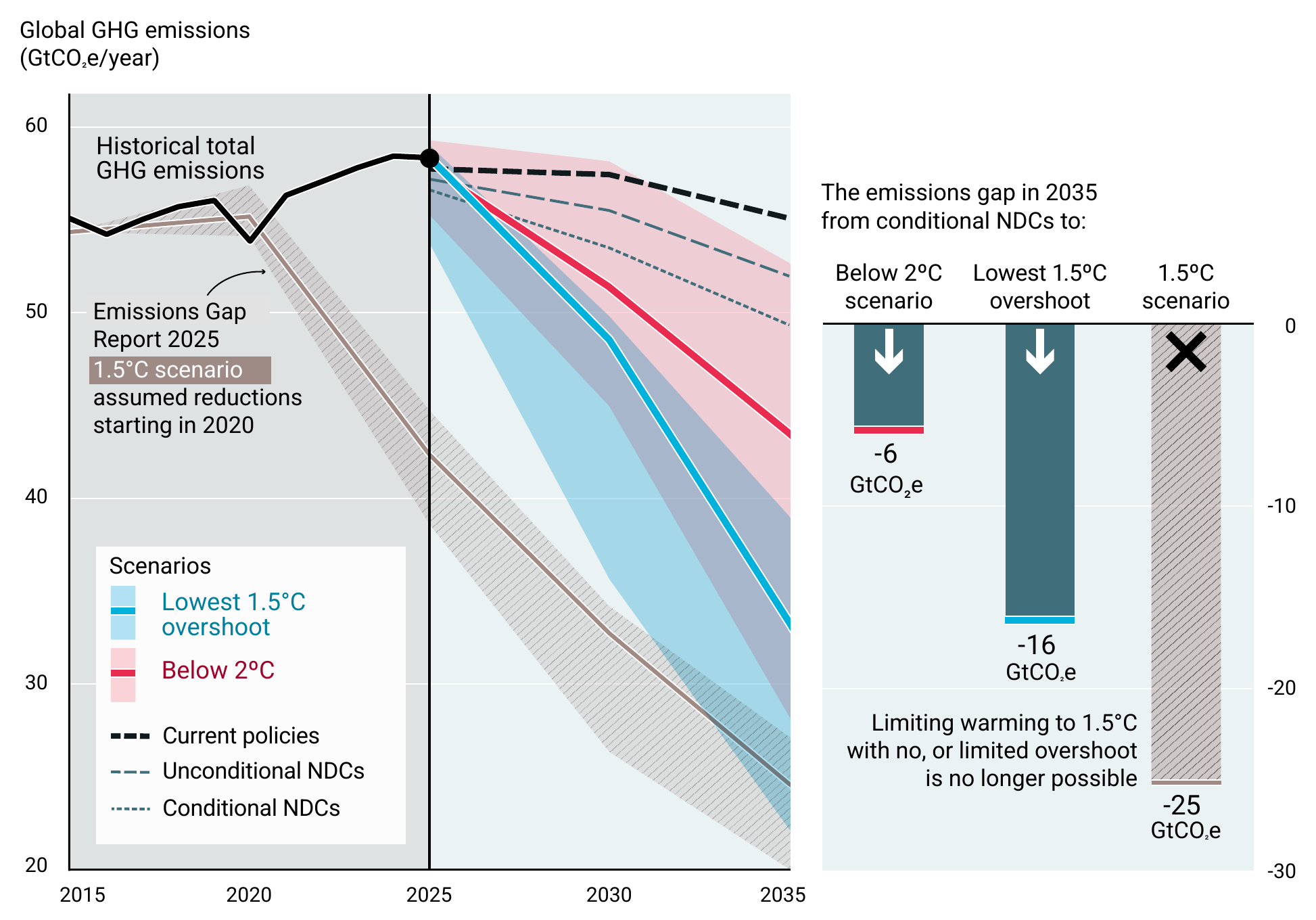
21 October 2026 (UNEP) – The headline finding of this seventeenth Emissions Gap Report is sobering. The opportunity to bridge the 1.5°C emissions gap with ‘no or limited’ overshoot has been lost. Decades of insufficient mitigation action means that larger exceedance of 1.5°C above pre-industrial levels based on multidecadal averages is now imminent and unavoidable.
Exceedance does not mark a single uniform state of risk. Every additional fraction of a degree and additional year of warming above 1.5°C raises the risk of irreversible changes including in ice sheets, permafrost carbon, ocean circulation and coral systems, along with devastating human impacts. The task now, therefore, is not only to ensure that global warming stays well below 2°C, but to minimize the duration and magnitude of overshoot and establish a credible return path to 1.5°C by the end of the century.
This year’s report responds to this new reality by providing an initial assessment of such new overshoot pathways. It redefines the emissions gap against a ‘lowest possible’ 1.5°C overshoot scenario, which assumes that stringent mitigation action starts from 2025 and is characterized by limiting peak warming to 1.7–1.8°C with 66 per cent chance, and returning global mean temperatures to or below 1.5°C by 2100 with around a 50 per cent chance. This scenario is still aligned with the long-term temperature goal of the Paris Agreement to limit global warming to well below 2°C, while pursuing 1.5°C. To get on such a pathway, global greenhouse gas (GHG) emissions must be reduced by 18 per cent by 2030, 45 per cent by 2035 and 69 per cent by 2040, all relative to 2025 levels. By contrast, the full implementation of the new nationally determined contributions (NDCs) submitted by around two thirds of all countries would reduce emissions by 5–8 per cent by 2030 and 11–15 per cent by 2035 relative to 2025 levels.
As the report also shows, there is ample opportunity to accelerate action. Since the adoption of the Paris Agreement, global developments in solar photovoltaics and wind deployment have continuously outpaced even the most optimistic forecasts. Growth in fossil fuels has been slower than predictions made ten years ago, and there is evidence that climate policies have real effects on reducing emissions. These developments are reflected in global progress across several of the action areas of the first global stocktake. The pace must be accelerated, but opportunities to do so exist.
The call to Governments remains fundamentally unchanged. What has changed is the context. The opportunity to limit warming to 1.5°C without overshoot has been lost, but the future remains crucially dependent on decisions taken today. Countries can still limit peak warming, shorten the duration of overshoot and keep the goals of the Paris Agreement within reach. Doing so requires faster, deeper and sustained emission reductions starting immediately, as well as large-scale removals of carbon dioxide (CO2) from the atmosphere.
1. Global GHG emissions in 2025 were similar to 2024 levels
Global GHG emissions reached a total of 58.4 gigatons of CO2 equivalent (GtCO2e) (range: ±5.5) in 2025. Preliminary estimates suggest this to be a slight decline of 0.1 GtCO2e from 2024 levels (figure ES.1), but it is not possible to conclude on the overall direction of emissions in 2025, due to the high uncertainty range. Nonetheless, this diverges from a trend of growth in global emissions over the past decade of 0.8 per cent per year, and of 1.7 per cent per year for the period between 1990 and 2016.
However, CO2 emissions from fossil fuel combustion of oil, coal and gas, and nitrous oxide (N2O) and fluorinated gases (F-gases) emissions continued to increase in 2025, while methane (CH4) emissions remained almost the same as in 2024.
These increases were offset by a decrease in CO2 emissions from the land use, land-use change and forestry (LULUCF) sector of about 0.5 GtCO2e. The decrease in LULUCF CO2 emissions was partially driven by a decline in biomass-burning emissions, including a decline in global wildfire carbon emissions in 2025, compared with the exceptionally active 2024 season.
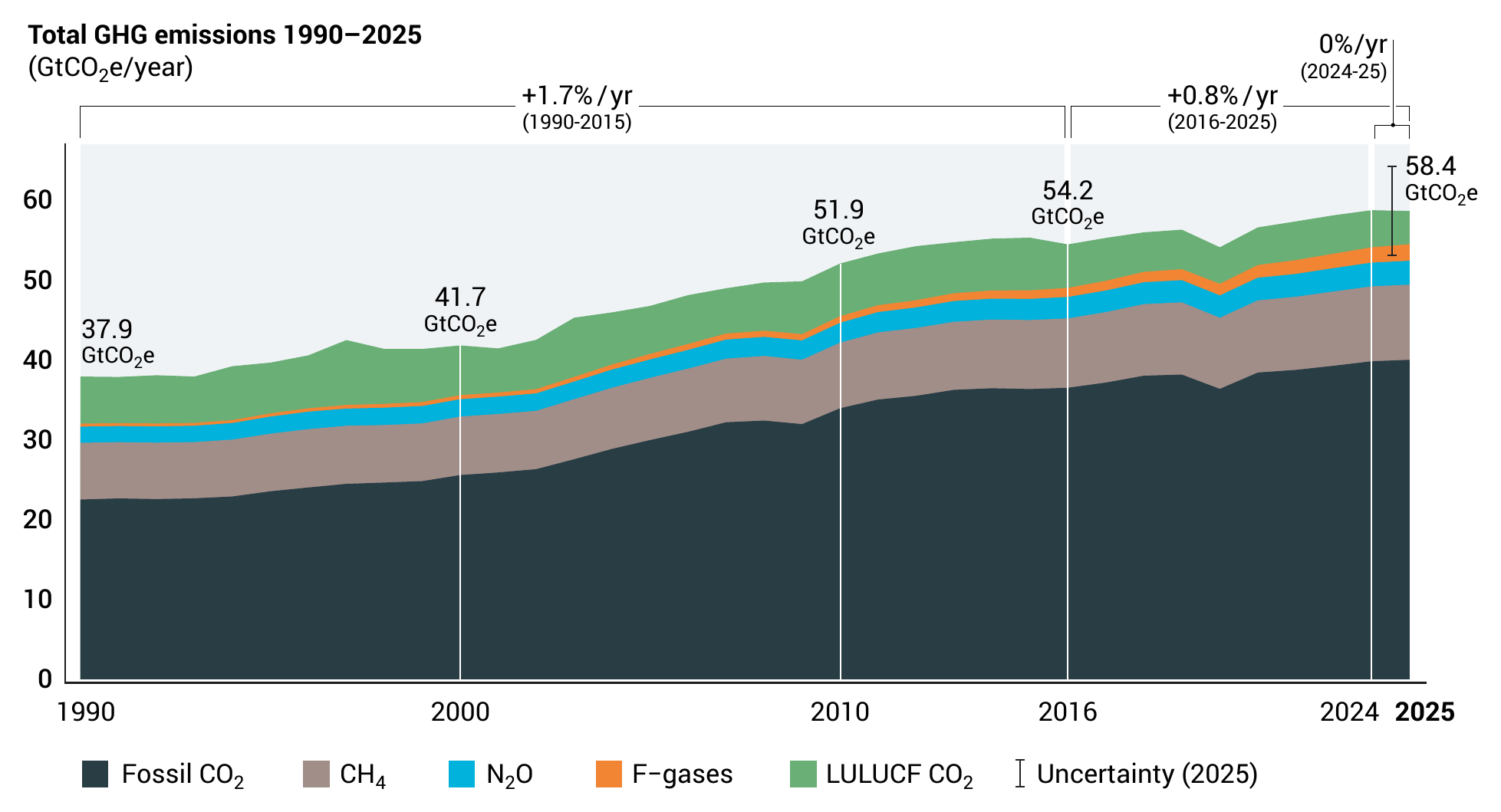
Based on these trends, it is too soon to conclude that global emissions are plateauing or peaking. Collectively, G20 members, excluding the African Union, account for 76 per cent of global emissions, and their emissions excluding LULUCF increased by 0.7 per cent in 2025.
Overall, while 63 countries decreased their emissions over the past decade (totalling -1.8 GtCO2e), these were outweighed by 124 countries increasing their emissions (totalling +7.2 GtCO2e). Several countries with high per capita and historical emissions have still to peak their emissions. […]
5. The opportunity to limit warming to 1.5°C with no or limited overshoot has been lost – stringent mitigation action could still return global warming to or below 1.5°C by the end of the century
After decades of insufficient climate action, it is no longer possible to close the gap between current climate pledges and a pathway that limits warming to 1.5°C with no or limited overshoot, defined as a temporary exceedance of less than 0.1°C. While it is now inevitable that warming will exceed 1.5°C by more than 0.1°C, it is still possible to minimize the magnitude and duration of this overshoot, and to return global warming to or below 1.5°C by the end of the century.
This conclusion builds on newly developed mitigation pathways, which are replacing the outdated scenarios from the Intergovernmental Panel on Climate Change Sixth Assessment Report (IPCC AR6). The new pathways, which will inform the IPCC AR7, acknowledge the failure to cut emissions to date, and apply a set of guardrails for feasibility and sustainability. Starting with stringent mitigation action from 2025, the lowest 1.5°C overshoot scenario that is still available has a 66 per cent chance of limiting peak warming to 1.7–1.8°C, while returning global warming to 1.5°C by 2100 with around a 50 per cent chance. The below 2°C scenario, which has also been updated with emissions cuts starting from 2025, has a 66 per cent chance of limiting peak warming to 1.9°C (table ES.1).
In addition to higher peak warming, the lowest 1.5°C overshoot scenario creates a need for aggregate CO2 removal from the atmosphere and its permanent sequestration of roughly 320 GtCO2 over the course of this century in order to return warming to 1.5°C by 2100. Our ability to remove such large amounts of CO2 from the atmosphere is uncertain, because of socioeconomic and technological challenges to the scale-up of CO2 removal measures and technologies.
Importantly, without stringent mitigation action from 2025, the lowest 1.5°C overshoot pathways available today will also slip away, undermining the possibility of achieving the temperature goal of the Paris Agreement. Every five years of emissions at current levels adds around 200 GtCO2 to the atmosphere, and pushes the peak warming up by around 0.1°C.
6. The emissions gap is still large: new NDCs reduce global emissions 5–8 per cent below 2025 levels by 2030, and 11–15 per cent by 2035, whereas 18 and 45 per cent are required for the lowest 1.5°C overshoot scenario
To secure the lowest 1.5°C overshoot scenario, countries need to make immediate, deep, rapid and sustained cuts in global GHG emissions of 18 per cent (range: 15–36) from 2025 levels by 2030, 45 per cent (range: 30–60) by 2035 and 69 per cent (range: 60–76) by 2040. Global CO2 emissions would still need to reach net zero by 2050 (range: 2046–2058), around which time temperatures also peak.
To meet these new lowest 1.5°C overshoot benchmarks, Parties must collectively reduce their emissions by an average annual rate of 5.7 per cent (range: 3.4–8.7) between 2025 and 2035. This necessitates even more rapid action than would previously have been required to limit warming to 1.5°C with no more than 0.1°C of overshoot, starting in 2019: the previous benchmark of cutting emissions to 43 per cent below 2019 levels by 2030 required an average reduction rate of 5.0 per cent per year.
The updated below 2°C scenario also relies on an immediate peak and decline in emissions of 11 per cent by 2030 (range: 0–23), 24 per cent by 2035 (range: 9–51) and 37 per cent by 2040 (range: 26–73), all relative to 2025 levels.
Despite new submissions since last year, the latest NDCs will neither deliver the cuts needed to align with the lowest 1.5°C overshoot scenario, nor the below 2°C scenario. They are only sufficient to cut emissions to 5–8 per cent below 2025 levels by 2030, 11–15 per cent by 2035 and 20–27 per cent by 2040, depending on the conditionality of NDCs.
This means there is a large and expanding emissions gap of 5 GtCO2e in 2030 and 16 GtCO2e in 2035, between the full implementation of current conditional and unconditional NDCs and the lowest 1.5°C overshoot scenario. For the below 2°C scenario, the gaps are 1 GtCO2e and 5 GtCO2e respectively. The gaps are even larger if only unconditional NDCs are implemented (figure ES.4, table ES.2).
These gaps are not directly comparable with last year’s report, which was benchmarked against scenarios that are now unachievable. Specifically, there is now an unbridgeable gap of 9 GtCO2e in 2035, between the lowest 1.5°C overshoot scenario and the level of emissions that would have been consistent with limiting global warming to 1.5°C with an overshoot of no more than 0.1°C (figure ES.4).
| Scenario | Projected GHG emissions (GtCO2e) | Estimated emissions gap to lowest 1.5°C overshoot scenario (GtCO2e) | Estimated emissions gap to below 2°C scenario (GtCO2e) |
|---|---|---|---|
| 2030 | |||
| Current policies | 57 (53–62) | 9 (4–13) | 5 (0–9) |
| Unconditional NDCs | 55 (51–59) | 7 (3–11) | 3 (-1–7) |
| Conditional NDCs | 53 (50–56) | 5 (2–7) | 1 (-2–3) |
| 2035 | |||
| Current policies | 55 (52–61) | 22 (18–28) | 10 (7–16) |
| Unconditional NDCs | 52 (49–55) | 19 (15–22) | 7 (4–11) |
| Conditional NDCs | 49 (47–52) | 16 (14–19) | 5 (3–7) |
7. Temperature projections have increased slightly compared with last year – only the scenario based on current policies remains unchanged
If current policies continue, there is a 66 per cent chance that warming will be limited to 2.8°C by 2100, while continuing to increase thereafter (figure ES.5).
If all NDCs are delivered and similar efforts continue, there is a 66 per cent chance that warming will be limited to 2.6°C by 2100. This is a worse outcome than expected last year, as a result of the formal withdrawal of the United States of America from the Paris Agreement and revised estimates of historical emissions. New NDCs submitted since last year have a near-zero impact on expected emissions and warming.
In the most optimistic pledge-related scenario considered in the report, where all NDCs and net-zero targets are achieved, and similar efforts are maintained thereafter, there is a 66 per cent chance that global warming will be limited to 2.1°C this century, 0.7°C below current policies. Again, this is worse than expected last year due to the withdrawal of the United States of America, and revised historical emissions estimates.
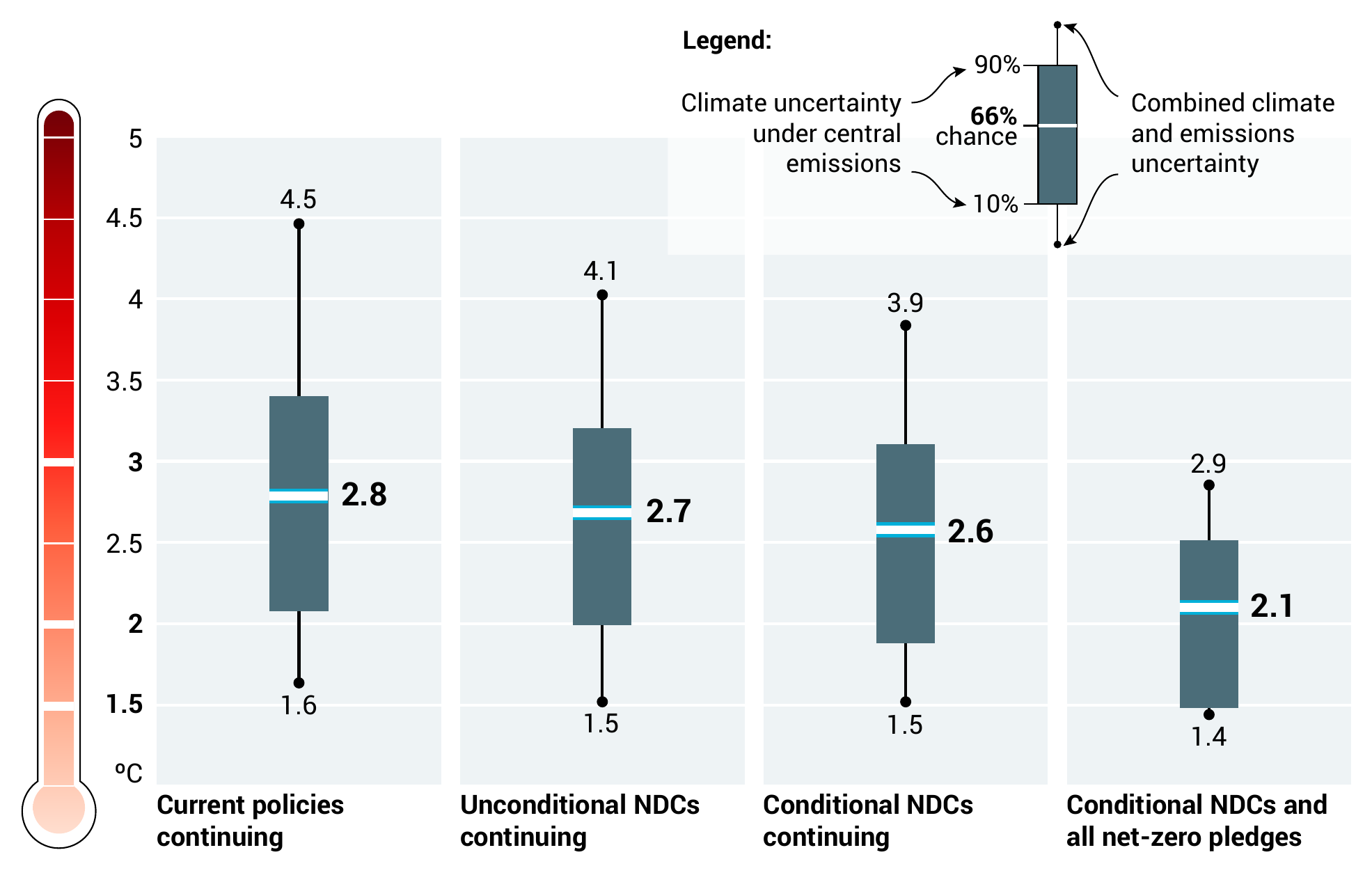
The most optimistic pledge-based scenario is the only case with a greater than 50 per cent chance of limiting warming this century to below 2°C – and a non-zero chance for returning to 1.5°C.
This shows that immediate and effective implementation of all pledges, including long-term net-zero targets, could significantly reduce expected warming. However, even the most optimistic pledge-based scenario results in around 0.25°C more peak warming than the lowest 1.5°C overshoot. This highlights the need to go beyond existing pledges, and to deliver on more ambitious pledges through accelerated action.
8. The world agreed to strong sectoral goals and actions in the first global stocktake. Most require urgent acceleration
The first global stocktake underscored the need for deep, rapid and sustained reductions in GHG emissions to keep the temperature goal of the Paris Agreement within reach. To that end, Parties agreed to the collective tripling of renewable energy capacity and doubling of the annual rate of energy efficiency improvements by 2030, transitioning away from fossil fuels in energy systems, accelerating the uptake of zero- and low-emissions technologies, reducing non-CO2 emissions, and halting and reversing deforestation and forest degradation.
Significant progress has been made since the adoption of the Paris Agreement in 2015. Global solar and wind deployment has expanded far more rapidly than anticipated a decade ago. Global renewable electricity capacity grew three times faster than current policies scenarios anticipated in 2015, with solar photovoltaics build-out increasing seven times faster than anticipated. […]
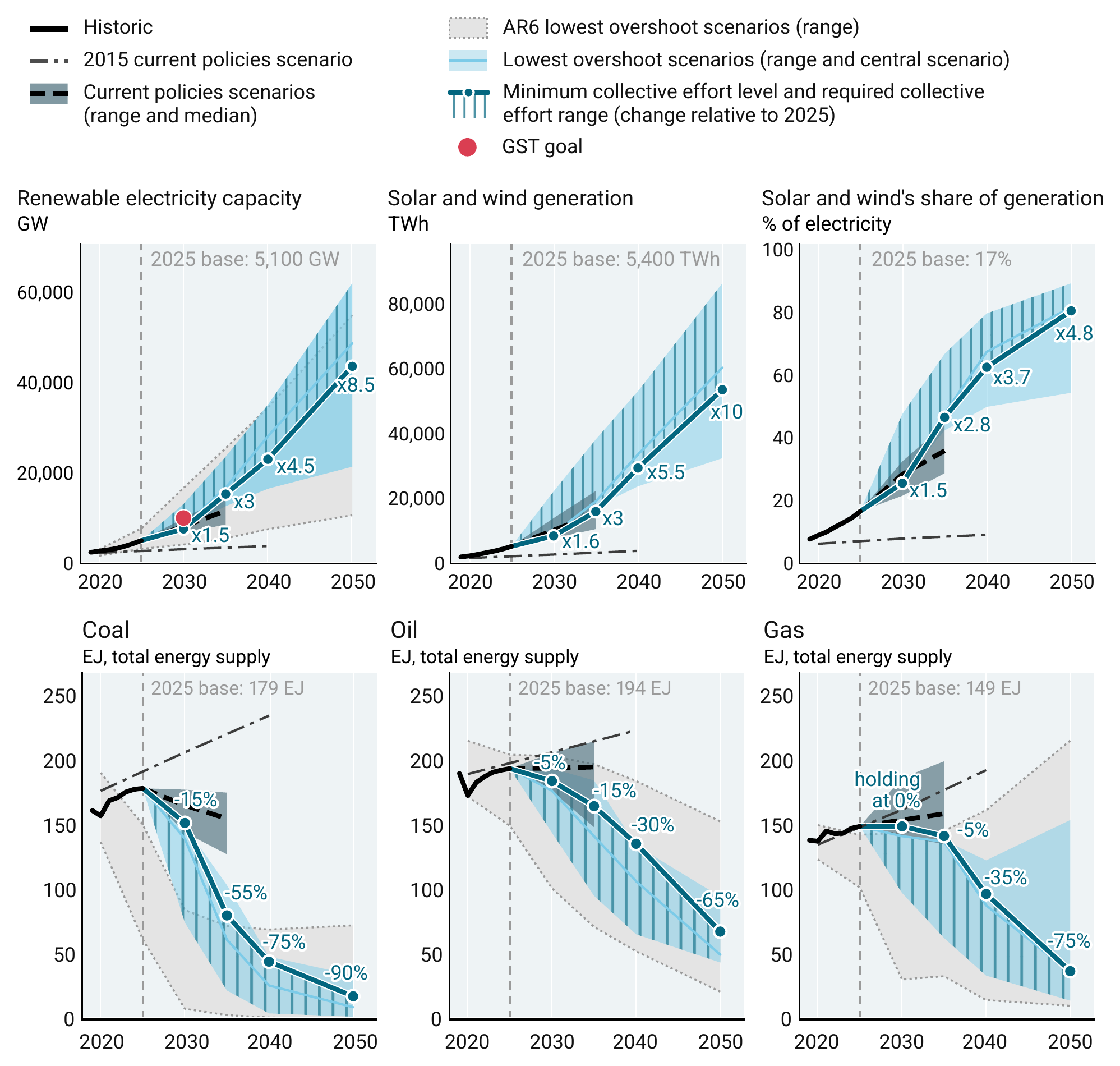
Despite these advances, progress across most global stocktake action areas remains insufficient. Recent rates of change across all indicators tracking absolute GHG emissions, including CO2 emissions in energy systems, road transport emissions and non-CO2 emissions, notably methane emissions, are heading in the opposite direction to the global stocktake targets. While current policies scenarios project that these emissions will stabilize by 2030 across some sectors, none show declines occurring at the pace and scale needed to minimize the magnitude and duration of overshoot of 1.5°C. These trends highlight that scaling up zero- and low-carbon technology adoption alone will not be sufficient to achieve the global stocktake’s outcome.
Progress in transitioning away from fossil fuels and other emissions-intensive activities is lagging particularly far behind. Total energy supply from coal, oil and gas continues to rise globally, albeit at a slower rate than was projected in 2015. Looking ahead, while the implementation of current policies is set to trigger a peak and decline in coal before 2030, use of oil and gas will likely continue to increase this decade.
Global efforts to halt deforestation by 2030 also remain significantly off track. Although permanent forest loss has slowed, the current rate of decline must accelerate by more than a factor of ten to meet the target of the first global stocktake. [more]